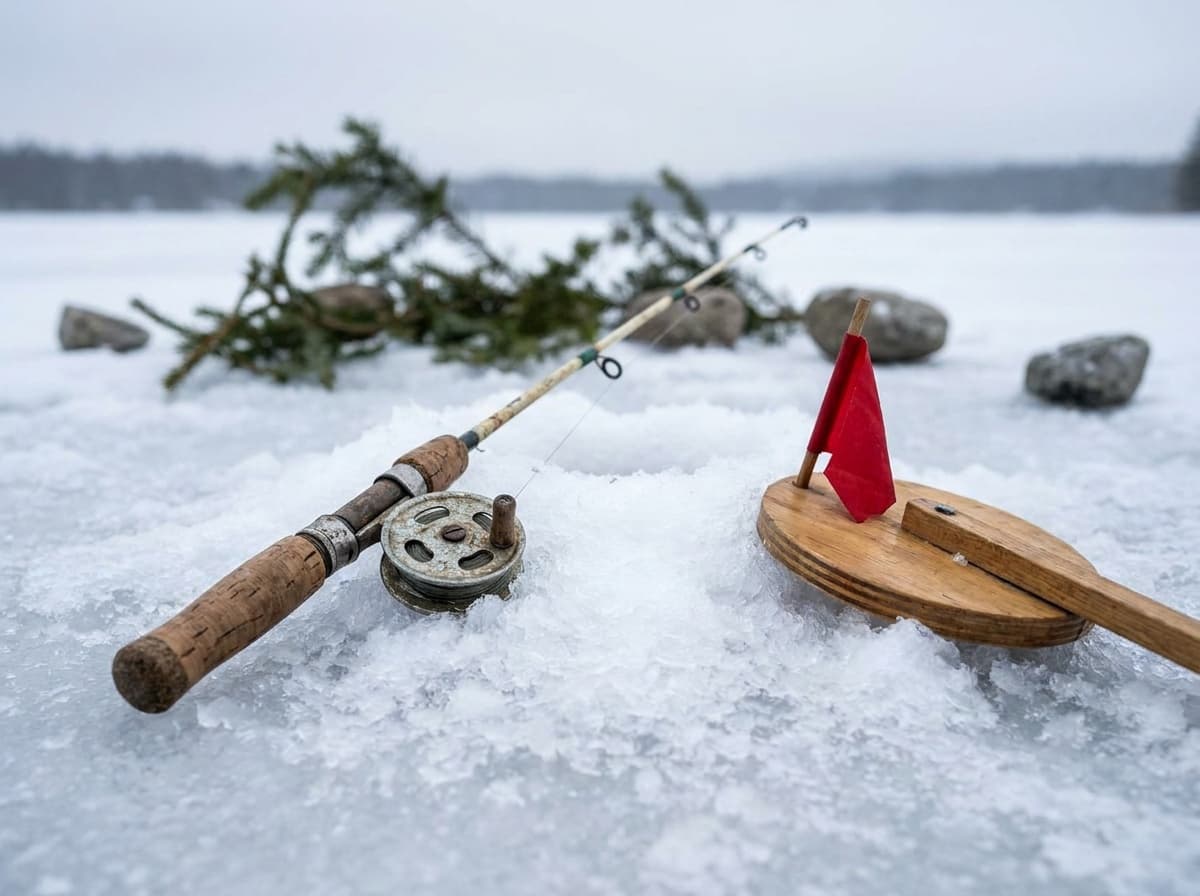
Every ice angler eventually has this argument, usually while a flag flies during the best jigging flurry of the day. The honest answer is that jigging and tip-ups are not competitors but two halves of one system, and the anglers who ice the most fish are usually running both. Here is how each works, where each dominates, and how to combine them legally.
How each method works
Jigging is rod-in-hand fishing through a single hole: a spoon, jig, or bait worked vertically, usually with sonar showing the lure and the fish's response in real time, as covered in our flasher guide. The angler hunts, drills, checks, moves, and adjusts cadence constantly.
Tip-ups are unattended live bait stations. A spool of line sits under the ice on a frame spanning the hole; a minnow swims below on a leader; when a fish takes and pulls line, a spring-loaded flag pops up. The angler walks or rides to the flag, hand-lines the fish, and resets. Classic rail-style tip-ups, insulated hole-cover designs that slow freeze-up, and windlass patterns that add motion to the bait all run the same basic game. A cousin device, the tip-down, drops a balanced rod toward the hole on light bites and fills the same role for panfish.
The honest comparison
| Factor | Jigging | Tip-ups |
|---|---|---|
| Water covered | One hole at a time, unlimited holes | A fixed spread, up to the legal line count |
| Angler role | Active every second | Passive until the flag |
| Best for | Bluegill, crappie, perch, aggressive walleye | Pike, roaming walleye, big-bait fish |
| Reads fish mood | Yes, in real time on sonar | No, only results |
| Cold and wind tolerance | Demands exposed hands and attention | Waits patiently in any weather |
| Learning curve | Cadence and sonar skills compound for years | Rigging basics learned in one outing |
| Social fit | Solitary focus | Group fishing built around flag chases |
When jigging wins. Panfish almost always: the tiny presentations from our panfish playbook cannot be fished passively. Fast search situations, when fish are scattered and the plan is drilling until the flasher lights up. Pressured or neutral fish, where live adjustment converts lookers that a static bait never would.
When tip-ups win. Pike, emphatically: a lively minnow under a flag on a weed flat is the classic hardwater pike program, and heavy leaders and big baits fish better unattended. Walleye edges at prime time, where a spread across a bar's whole face catches the school wherever it slides through, per our walleye guide. Long sits with kids or groups, where flag chases turn waiting into the fun part. And any day cold enough that exposed jigging hands give out before the fish do; our clothing guide helps, but flags do not get cold.
Running both: the combined system
The standard division of labor puts tip-ups on the coverage job and the jigging rod on the precision job. An example evening walleye set within a three-line allowance: two tip-ups with live fatheads spaced along a breakline, one jigging rod working a spoon on the sharpest corner of the same structure. The jigging noise pulls fish to the neighborhood; the quiet live baits collect the ones that refuse hardware, the same one-two logic as the dead stick system.
Flag protocol keeps the combination fun instead of chaotic: walk, do not run, on glare ice; ice cleats save more tip-up days than any gadget; check whether line is still peeling before setting the hook by hand; and re-check bait and hole freeze-up on a regular loop in hard cold. A skimmer clears the jigging hole; insulated tip-ups largely mind their own.
Whichever mix you run, the spread changes your safety footprint: tip-ups pull anglers across more ice than a single jigging hole ever will, including spots nobody has walked yet. Check every line of travel the way our safety guide describes, verify thickness against DNR guidance as you expand, and remember that no ice is ever one hundred percent safe just because a flag is flying on it. Conditions for your lake are in the free Ice & Water Report.
Gear-wise, tip-ups are refreshingly cheap to enter and hard to outgrow; our best tip-ups roundup sorts the rail, insulated, and rod-based designs, and the ice fishing hub connects the rest of the system.
Can one angler realistically run tip-ups and jig at the same time?
Yes, and it is the standard advanced setup. The practical limits are distance and freeze-up: keep the spread close enough that a flag is reachable inside a minute or two, and in hard cold, shrink the spread so bait checks stay on schedule. Solo anglers in deep cold often drop to one tip-up plus the jigging rod; the system beats the count.
What bait goes on a tip-up?
Live minnows sized to the target: small fatheads or medium shiners for walleye, large shiners or suckers for pike, hooked lightly below the dorsal so they swim naturally. Pike rigs add a wire or heavy fluorocarbon leader; walleye rigs stay lighter with a small treble or single hook. Set walleye baits about a foot off bottom and pike baits anywhere from mid-column to just under the ice over weeds.
Do tip-ups spook fish in shallow water?
The device itself sits above the ice and spooks nothing; the commotion of flag chases can. On shallow weed flats, veteran anglers rig quietly, minimize re-checks, approach flags softly, and let a tripped spool run a beat before hand-lining. In water under six feet, the bigger variable is light and shadow through the hole, the same as when jigging.
What is the difference between a tip-up and a tip-down?
A tip-up suspends a baited spool under the ice and signals with a rising flag, built for fish that pull hard and run. A tip-down balances a light rod on a pivot so the rod tips toward the hole when a fish takes, protecting light line and showing delicate bites, which suits crappie and perch. Both count toward line limits; the choice tracks the target species' bite.