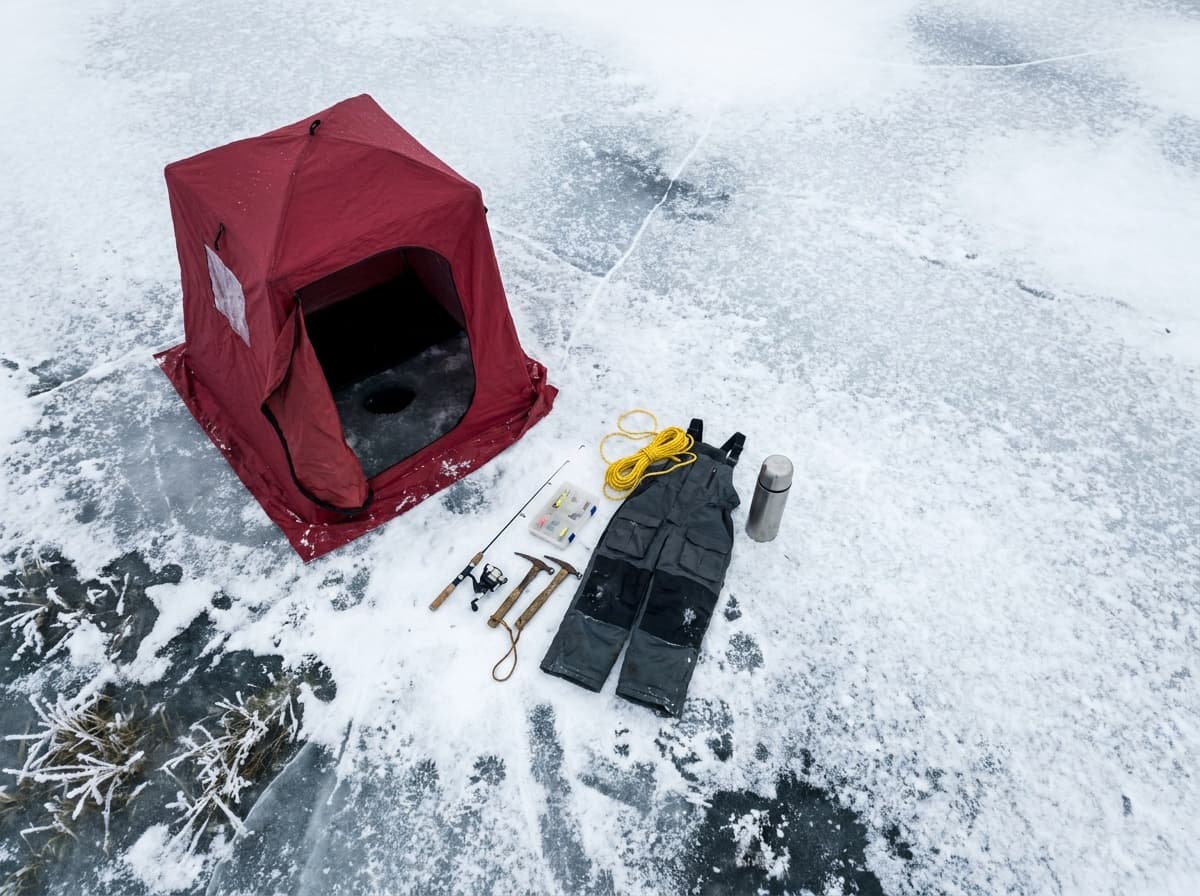
Ice fishing has one of the lowest true entry costs in outdoor sport, which surprises people who have only seen the villages of wheelhouses on famous lakes. Strip it down and the sport is a hole, a stick, and a spot where fish live. This guide covers the minimum kit, the first trip, and the habits that separate a fun first season from a cold one.
The starter kit
| Item | What it does | Beginner note |
|---|---|---|
| Fishing license | Legal requirement in every state | Buy online from your state DNR before the trip |
| Hand auger or spud bar | Cuts and checks the hole | A 6 inch hand auger drills fast and doubles as a thickness check |
| Ice rod and reel | Short rod, 24 to 28 inches, light or ultralight | Spooled with 2 to 4 lb monofilament for panfish |
| Small jigs and spoons | The business end | A few tungsten jigs, sizes 3 to 5 mm, plus one small spoon |
| Live bait | Waxworms, spikes, or fathead minnows | Local bait shops know what is working |
| Ice skimmer | Clears slush from the hole | The most-forgotten five dollar item in the sport |
| Bucket or sled | Carries gear, becomes the seat | A 5 gallon bucket is the classic starter |
| Ice picks and rope | Self-rescue essentials | Wear the picks around your neck, always |
| Warm boots and layers | Sitting still is colder than moving | See our what to wear guide |
That list catches fish. When you are ready to upgrade, the usual order is a flasher first, then a shelter, then a lithium power auger. Our roundups of the best ice fishing flashers, best ice augers, and best ice shelters cover those decisions in detail.
Safety comes before tactics
No ice is ever one hundred percent safe, and that sentence is the foundation of the whole sport. Before anything else:
- Learn the DNR thickness guidelines: 4 inches of new, clear ice minimum for foot travel, double that for white or refrozen ice.
- Go with an experienced angler for your first trips, and tell someone on shore where you are going and when you will be back.
- Wear ice picks, carry a throw rope, and check the ice as you walk. The full system is in our ice fishing safety guide.
- If you are heading to Lake Winnebago, Mendota, Monona, or Big Green Lake, check the observed water and weather context in the Ice & Water Report, then verify with local reports and your own measurements at the access.
Where to set up
Fish do not spread evenly under the ice. Three structure concepts cover most beginner situations:
Weed flats and weedlines. Early in the season, green weeds in 4 to 12 feet of water hold bluegill, perch, and the pike that eat them. Fish the edge where weeds give way to open bottom.
Drop-offs and points. Where the bottom falls from a flat into deeper water is a travel route. Walleye and perch slide up these edges in low light.
Basins. By midwinter, crappie and many bluegill suspend over the deepest soft-bottom areas of a lake. This is flasher territory, but a beginner can reach it by following the crowd, respectfully.
A lake map, even the free contour layer in a fishing app, turns this from guesswork into a plan. If you fish Wisconsin water, our Wisconsin where-to-start guide names specific lakes with live condition pages.
A simple first trip plan
- Arrive mid-morning on a mild day. Comfort beats prime time for trip one.
- Confirm thickness at the access, then follow the established foot path.
- Drill 4 to 6 holes across a depth change, from about 6 feet down to 12 or 15.
- Start shallow with a tungsten jig tipped with a waxworm, a foot off bottom.
- Jig softly: small lifts, small shakes, then hold still. Most panfish bite the pause.
- No bites in 15 minutes? Move to the next hole. Ice fishing rewards movement, not patience for its own sake.
- Quit while you are still warm. Cold decisions get worse, not better.
Veteran hardwater anglers describe the sport as hunting more than waiting: the anglers who catch fish are usually the ones who drill the most holes.
What to expect from the fish
Panfish are the honest first target: bluegill, crappie, and perch bite through the whole season, fight well on light gear, and make the best meal in freshwater. Walleye are the classic step two, mostly a dawn and dusk pursuit covered in our walleye through the ice guide. Timing matters more than most beginners expect, and our guide to the best times to ice fish explains the season's rhythm. The complete progression lives in the ice fishing hub.
Do I need a shelter to ice fish?
No. On mild days, sitting on a bucket in the open is how most anglers start. A shelter earns its cost when wind, deep cold, or long sits enter the picture, and a flip-over or hub shelter changes what weather you can fish comfortably. Treat it as a second-season purchase unless you run cold.
What live bait should a beginner buy?
For panfish, waxworms and spikes (fly larvae) on small tungsten jigs cover almost everything. For perch and walleye, small fathead minnows work on jigs or under tip-ups. Buy bait locally: shops stock what the nearby lakes are producing on, and the counter conversation is free scouting.
How thick should the ice be before I go?
DNR guidance calls for at least 4 inches of new, clear ice for travel on foot, and roughly double that for white, layered, or refrozen ice. Nobody measures the lake for you, so verify at the access and as you walk. The full chart and checking method are in how thick does ice need to be.
Is ice fishing expensive to start?
A license, a hand auger, a rod combo, jigs, bait, and a bucket typically come in far below the cost of most outdoor hobbies' entry points, assuming you already own warm winter clothing. The expensive versions of the sport, wheelhouses, power augers, and live sonar, are upgrades, not prerequisites.