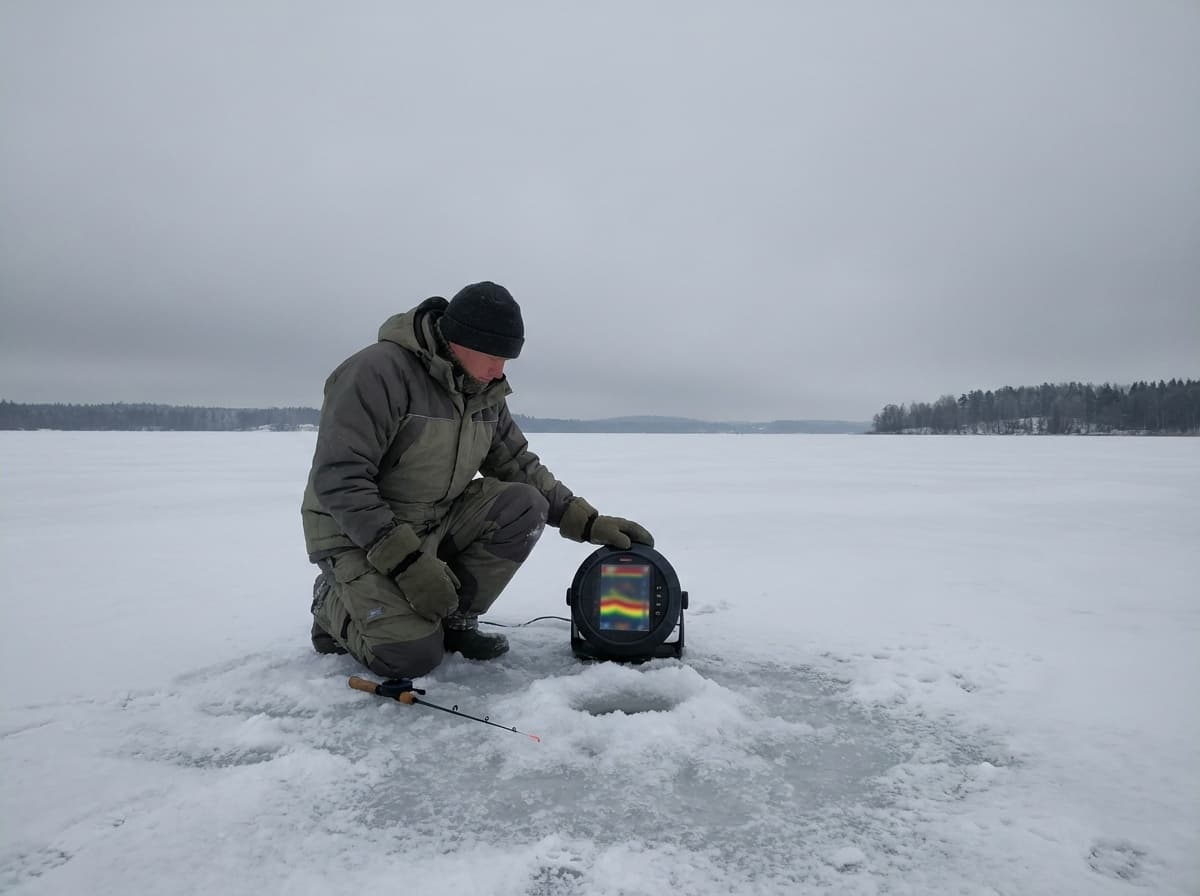
Veteran hardwater anglers describe the flasher as the moment ice fishing changes from waiting to hunting. You stop guessing whether fish are under you and start reacting to what they do. The learning curve is real but short: one afternoon of jigging over a school of bluegill teaches most of it. Here is the head start.
The three things on every dial
Every flasher, regardless of brand, shows three fundamentals on a circular depth scale:
| Signal | What you are seeing | How to confirm |
|---|---|---|
| Wide, strong band at the deepest point | The bottom | It stays put when everything else moves |
| Thin mark that moves when you move | Your jig or spoon | Lift the rod a foot; the mark climbs |
| Marks appearing between jig and surface | Fish, usually | They move on their own and change strength |
Depth reads directly off the scale. If the bottom band sits at 18 on a 0 to 30 scale, you are fishing 18 feet of water. A second, fainter echo at exactly double the depth is a rebound of the bottom signal, not a school of fish.
Color is signal strength, not species
On a classic three-color flasher, red means a strong return, orange or yellow a medium one, and green a weak one. Strength is a function of target size, density, and position in the sonar cone:
- A fish directly under the hole paints stronger than the same fish at the cone's edge.
- A thick line that stays red as it moves is typically a larger fish or one dead-center in the beam.
- A green flicker that strengthens to orange, then red, is a fish swimming into your cone, exactly the moment to pay attention.
The practical rule from experienced anglers: watch changes, not colors. A weak mark getting stronger is approaching. A strong mark fading is leaving. That direction of change tells you whether your presentation is working.
Set the gain low
Gain (sensitivity) is the most misused knob on the ice. Run it too high and the dial fills with noise, double echoes, and a jig signal so thick it swallows incoming fish. The standard setup, echoed across manufacturer guidance and veteran practice, is to turn gain down until the display is clean, then up just until your jig draws a crisp, thin line at fishing depth. Re-tune when you change depth or lure weight: a 3 mm tungsten jig in 25 feet needs more gain than a rattle spoon in 8 feet.
Reading fish mood
The dial is a mood ring. A few patterns cover most encounters:
The riser. A mark appears below your jig and climbs toward it. Keep the lure doing what it was doing, or slowly lift it away. Making a fish chase converts far more bites than dropping the lure into its face.
The stalker. A mark holds a few inches under the jig without committing. Downsize, slow the cadence to tiny shakes, or hold dead still. If it fades away, drop a size, not a depth.
The sled dog. Marks scream through at speed and vanish. Common with perch and aggressive crappie. Snap the jig harder to call the school back; aggression often recruits aggression.
The bottom bulge. The bottom band thickens or lifts slightly. On soft-bottom basins that is often walleye or perch pinned to the floor. Pound the bottom, puff the silt, then hold your jig 6 inches up.
Our walleye and panfish guides go deeper on species-specific dial behavior.
Flasher vs. graph vs. live sonar
Modern ice electronics come in three flavors. A flasher gives instant, latency-free feedback and runs all day on a small battery. LCD graphs show the same data as a scrolling history, easier for some eyes to read. Forward-facing live sonar shows fish approaching horizontally, at several times the cost and battery draw. The consensus among longtime ice anglers is that a flasher remains the best learning tool and the best value, which is why it anchors most serious kits. When you are ready to compare units, use our roundup of the best ice fishing flashers.
One more note for new buyers working through our beginner's guide: electronics change how you fish, not whether fish are present. Location still comes first, and no screen fixes a dead basin. No ice is ever one hundred percent safe, so check conditions and access with the Ice & Water Report, verify thickness on site, and keep the full ice fishing library close as your system grows.
What is the difference between a flasher and a regular fish finder?
Same sonar physics, different display. A flasher paints each ping instantly on a dial with zero scroll delay, which matters when a fish inspects a jig for two seconds. A graph-style finder scrolls history across a screen, showing where marks were a moment ago. Many units now offer both modes; anglers who jig actively tend to stay on the dial.
Why does my flasher show two bottoms?
A second band at exactly twice the true depth is a double echo: the ping bounced lake bottom to ice to bottom again. It usually means your gain is set higher than needed. Turn sensitivity down until the second echo fades and your jig still draws a clean line.
Will other anglers' flashers interfere with mine?
Nearby transducers on similar frequencies can paint rotating noise bands on your dial. Most modern flashers have an interference rejection setting that shifts timing until the noise clears; cycling through its levels usually solves it. Moving your hole a few feet farther from the neighbor helps too.
Do flashers work for shallow water ice fishing?
Yes, with adjustments. In water under about 6 feet the cone is narrow and the jig sits close to the bottom band, so drop to the lowest gain, use a shallow range if your unit has one, and consider watching the fish directly down the hole instead. Sight fishing shallow weed flats is one situation where eyes beat electronics.