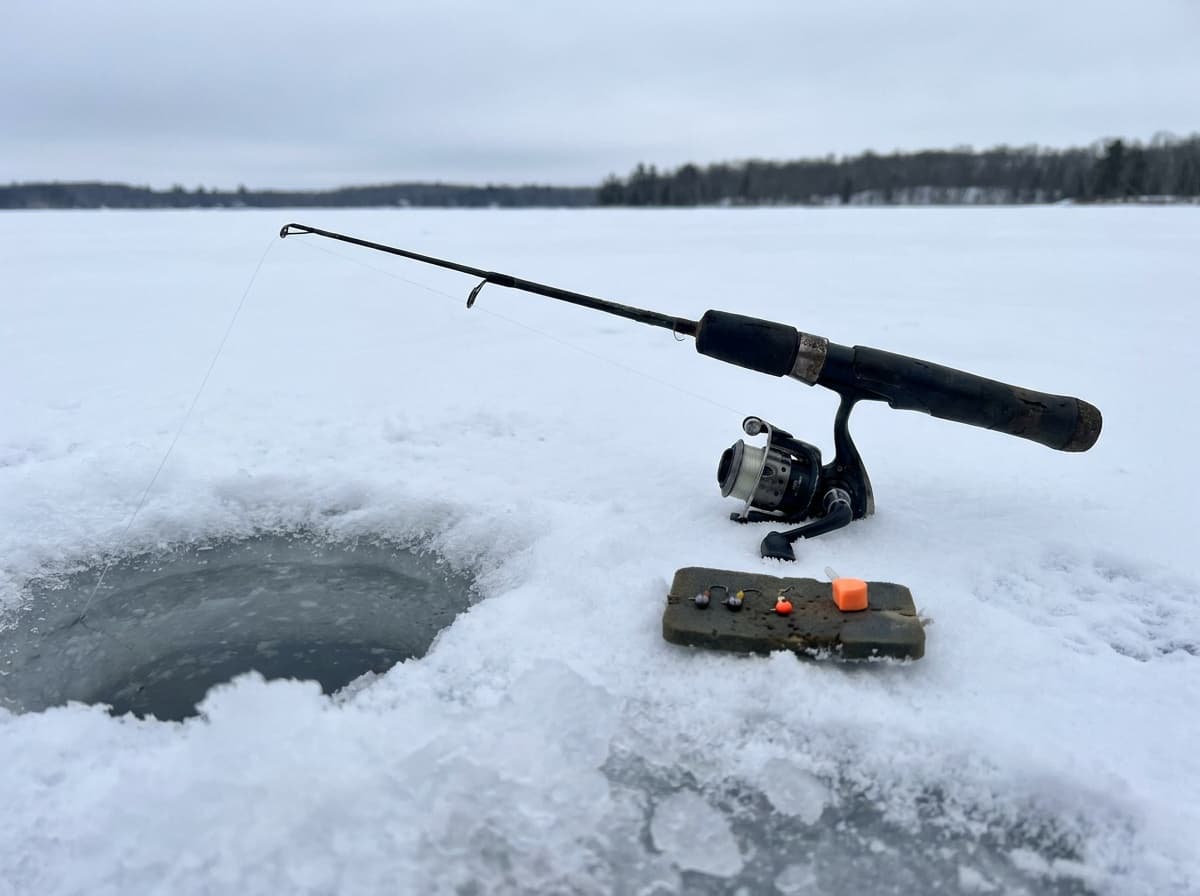
Panfish are the engine of ice fishing. They bite all winter, live in most lakes, tolerate beginner mistakes, and still offer enough refinement to occupy the most obsessive veteran. They are also the sport's best classroom: everything about electronics, cadence, and mobility that our beginner's guide introduces gets learned fastest over a school of bluegill.
Three species, three programs
| Species | Prime locations | Season pattern | Peak windows |
|---|---|---|---|
| Bluegill | Green weed flats and edges, 4-12 ft; deep basin mud in midwinter | Shallow early and late, deeper midwinter | Midday through afternoon |
| Crappie | Suspended over 20-40 ft basins; weed edges at first and last ice | Basin-oriented midwinter | Dusk and after dark |
| Perch | Sand, gravel, and mud flats; deep basin invertebrate beds | Roaming schools all season | Morning and midday |
Bluegill stay tied to vegetation as long as it stays green and oxygenated. First ice finds them in the same 4 to 12 foot weed flats they used in fall; as weeds die back midwinter on fertile lakes, the bigger fish slide to basin mud and feed on invertebrates. Late ice brings the whole population shallow again for the year's best sight fishing.
Crappie are the suspended fish. Through midwinter they hang in loose clouds over the deepest soft basins, often 5 to 15 feet off bottom, drifting and feeding in waves with a strong dusk-into-dark peak. On the flasher they appear as stacked marks well off the floor, the situation bottom zoom was made for, as covered in our flasher guide.
Perch are the wanderers. Schools graze across flats and basins, here for twenty minutes and gone, which makes perch fishing a drilling sport: a dozen holes across a flat, run and gun until the school is under you, then catch quickly while it stays.
The tackle, downsized
Winter panfish tackle is small because winter forage is small: invertebrates, larvae, and tiny minnows. The standard kit:
- Tungsten jigs, 3 to 5 mm. Tungsten's density gets a tiny profile down fast and telegraphs bottom contact. Bring a range of weights and two or three colors; profile and size matter more than paint.
- Plastics and live larvae. Micro plastics fish faster and select bigger fish on many days; waxworms and spikes convert the stubborn ones. Carrying both is not a compromise, it is the system.
- 2 to 3 lb line. Light line lets a 3 mm jig move naturally and doubles your bites in clear water. Check it for curl and re-tie often.
- A soft-tip rod or spring bobber. Midwinter bluegill frequently rise to meet a jig and hold it without pulling; the bite reads as weightlessness or a slow rise of the tip. If you cannot detect an up-bite, you are missing half your fish.
Deeper buying guidance lives in our roundups of the best ice fishing rods and best ice fishing flashers; for now, any light combo with fresh line and a handful of tungsten catches fish.
Fishing the flasher, panfish edition
Panfish are where sonar skills compound. The workflow veteran hardwater anglers repeat all winter: drill a line of holes across the target structure before wetting a line, drop the transducer in each and look for thirty seconds, and fish only the holes showing life or prime cover. Over basins, watch for crappie clouds rising as light fades. Over weeds, run low gain and learn to see fish appear inside the vegetation clutter. Over mud, a bottom band that thickens is often perch or bluegill pinned tight; pound the silt and lift.
The 15 minute rule keeps it honest: no marks and no bites means the next hole, not more patience. Mobility is the difference between panfish trips that produce dinner and trips that produce excuses.
Where this plays in Wisconsin
The programs above map cleanly onto the waters in our Wisconsin starting guide: basin crappie and quality perch on the Madison chain's Mendota and Monona, suspended crappie over old river channels on Petenwell and Castle Rock, and classic weed-flat bluegill across the Minocqua area's hundreds of lakes. Check the four instrumented waters in the Ice & Water Report before the drive, verify thickness against DNR guidance at the access, and keep the full safety system in the sled; panfish water is often shallow, but no ice is ever one hundred percent safe at any depth. More species and gear coverage lives in the ice fishing hub.
Should I use plastics or live bait for panfish?
Run both in rotation. Plastics fish faster, skip the re-baiting, and often select larger bluegill and crappie; live larvae like waxworms and spikes win when fish are pressured or negative. A practical system starts each hole with a plastic and switches to live bait only for marks that inspect and refuse. Whichever you use, thread it straight; a spinning jig is the most common reason panfish refuse.
Why do crappie suspend so far off the bottom in winter?
They follow the food and the water quality. Zooplankton, the midwinter crappie staple, concentrate in layers of the basin's water column, and on fertile lakes the deepest water can also run low on oxygen by late winter, lifting everything upward. The practical rule is to trust the flasher over the depth finder: fish the level the marks show, even when it is 15 feet above bottom over 35 feet of water.
What time of day is best for winter panfish?
Bluegill and perch are the daytime fish, with late morning through mid-afternoon the steadiest producers, especially under bright sun on weed flats. Crappie flip the schedule, peaking at dusk and feeding into the night over basins. A classic full day fishes weeds for bluegill through midday and slides to the basin edge for the crappie hour as covered in our timing guide.
Do I really need 2 lb line for bluegill?
Clear water and small jigs, yes, it makes a measurable difference: light line lets tiny tungsten fall naturally and disappears to inspection-minded fish. Stained water and aggressive schools forgive 3 or 4 lb, which also handles the pike that crash panfish sets. The compromise many anglers run is 3 lb with a long, fine leader on clear lakes.