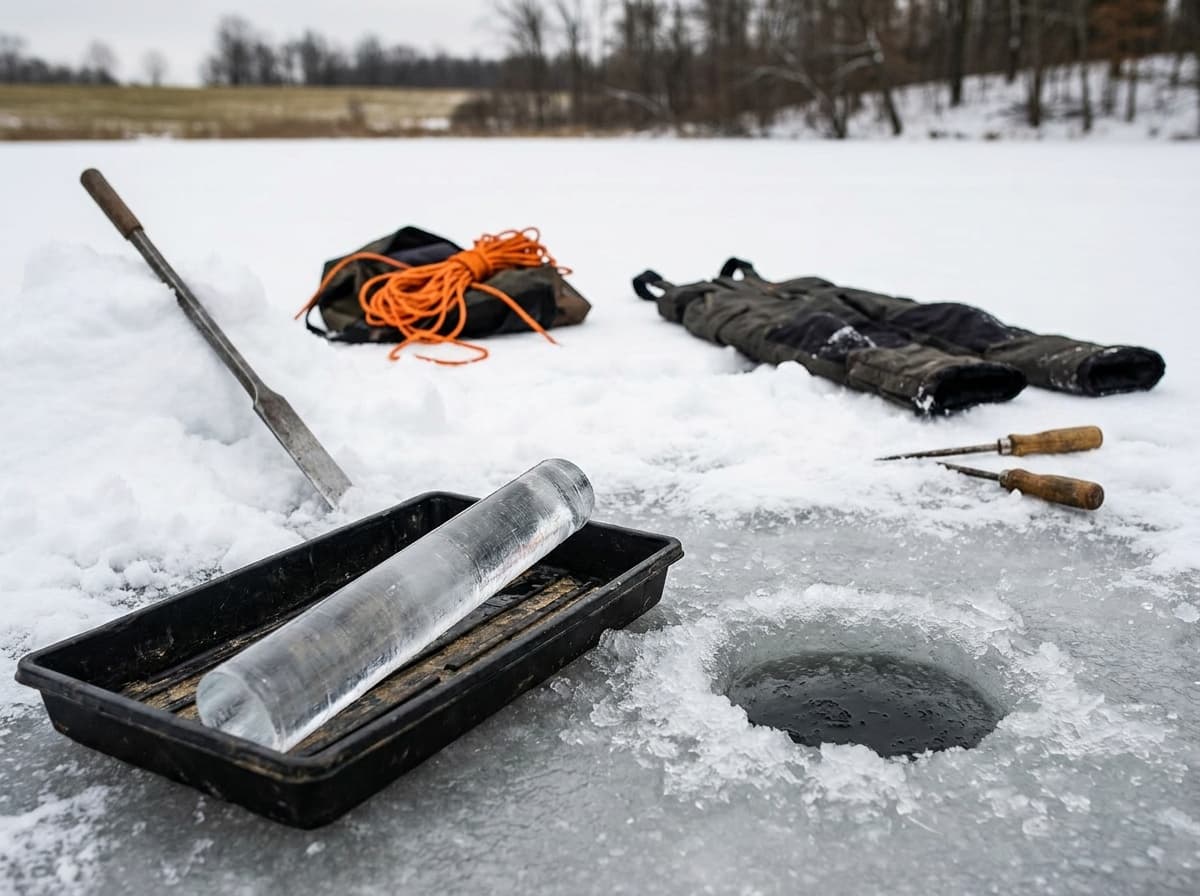
Every hardwater season starts with the same question, and the honest answer has two parts. The first part is a chart. The second part is a warning: the chart only applies to new, clear ice, and ice is never uniform across a lake. The Minnesota DNR, whose guidelines are the de facto standard across the ice belt, puts it plainly: ice can be two feet thick in one place and one inch thick a few yards away.
The DNR ice thickness chart
These are the Minnesota DNR's minimums for new, clear ice, the most widely cited guidance in North America. The Wisconsin DNR publishes similar numbers.
| Ice thickness (new, clear ice) | Activity |
|---|---|
| Under 4 inches | Stay off |
| 4 inches | Ice fishing or other activities on foot |
| 5 to 7 inches | Snowmobile or small ATV |
| 7 to 8 inches | Side-by-side ATV |
| 9 to 10 inches | Small car or SUV |
| 11 to 12 inches | Medium SUV or small truck |
| 13 inches | Medium truck |
| 16 to 17 inches | Heavy-duty truck |
| 20 inches or more | Heavy-duty truck with wheelhouse shelter |
Two details matter as much as the numbers. First, these figures assume solid, clear ice and average equipment weight; you are responsible for knowing what your vehicle, gear, and group actually weigh. Second, the DNR does not measure ice thickness on public lakes. Nobody does that for you. Local bait shops and fishing clubs track conditions on heavily fished water. For Lake Winnebago, Mendota, Monona, and Big Green Lake, our Ice & Water Report adds observed water and nearby weather context, but the only measurement that counts is the one you take at your feet.
Why 4 inches is the walking number
Four inches of new, clear ice is the point where DNR guidance considers travel on foot for a single angler. It is a minimum, not a comfort zone. The DNR notes that 4 inches of clear, newly formed ice may support one person, while a foot or more of old, partially thawed ice may not. New ice is generally stronger than old ice, which is why late-season ice that looks thick can be far weaker than early-season ice that looks thin.
The 4 inch line is not a group-capacity calculation. Clustering people concentrates load, so avoid gathering in one spot. Spacing does not make ice below the measured guidance acceptable for travel.
White ice cuts the numbers in half
When snow melts and refreezes on top of lake ice, it forms white ice, sometimes called snow ice. The Minnesota DNR states that white ice is only about half as strong as new, clear ice and advises doubling the chart when traveling on it. In practice, that means a spot with 5 inches of cloudy, layered ice does not meet the walking guidance at all.
Snow itself works against ice in two ways: it insulates the sheet, slowing new growth, and its weight reduces how much load the ice can carry.
How to actually check
The Minnesota DNR's guidance on checking thickness supports this conservative sequence:
- Start at the access with a spud bar. Solid, sharp strikes ahead of your path. If the bar punches through, back out the way you came.
- Drill a test hole within a few steps of shore and measure with a tape. If the reading is below the guideline for your plans, the trip ends there.
- Keep testing as you go. The DNR does not prescribe one universal spacing interval, so test repeatedly as conditions, surface appearance, or location change.
- Treat transitions with suspicion. Pressure ridges, inlets, bridges, culverts, current seams, and shoreline springs all produce thin spots surrounded by thicker ice.
Vehicles are a different conversation
Driving on ice multiplies every risk, and DNR guidance treats it accordingly. Cars, pickups, and SUVs should be parked at least 50 feet apart and moved every two hours, because a stationary load slowly sinks the sheet. Minnesota's guidance for parked loads runs far higher than the travel chart, up to 22 inches of effective thickness for a three-quarter-ton truck. The DNR's own fatality data shows why caution matters: vehicles, snowmobiles, and ATVs account for roughly two-thirds of Minnesota's ice-related deaths since 1976, per the DNR's fatality statistics.
If you are new to the sport, there is no version of this where a vehicle on the ice is the beginner move. Walk out, or stay on shore. Our ice fishing safety guide covers the gear and habits that go with every one of these decisions, our beginner's guide shows how much fishing you can do within a short walk of the access, and the guides library keeps the full planning sequence together.
Is 4 inches of ice enough for a group of anglers?
The 4 inch guideline applies to new, clear ice and does not guarantee capacity for a group. A tight group concentrates load, so avoid clustering people or holes. On white or refrozen ice, DNR guidance doubles the number to 8 inches before foot travel enters the conversation, and on-site measurements still control.
How thick should ice be for a permanent ice shanty?
A wheeled or skid shanty is a stationary load, which requires more ice than a moving one. Minnesota's stationary-load guidance starts at 6 inches of effective thickness just for a standing person and climbs steeply with weight; many anglers wait for well over a foot of clear ice before placing a heavy permanent shelter, and they still move it periodically. Check the DNR's guidance and your state's shelter regulations.
Does any agency measure ice thickness on lakes?
No. The Minnesota DNR states directly that it does not measure ice thickness on Minnesota lakes, and the Wisconsin DNR says the same and points anglers to local clubs, outfitters, and bait shops for current reports. Tools like our Ice & Water Report show observed water and weather context, but on-site measurement is always on you.
Is early ice or late ice more dangerous?
Both bookend periods demand extra care, for different reasons. Early ice is thin but usually new and clear, so its strength tracks the chart. Late ice is often thick but rotten: warm days, rain, and sun degrade it from the top and bottom, so a foot of honeycombed March ice can be weaker than 5 inches of December ice. The chart applies to new, clear ice only, which is why late season judgment leans on the spud bar more than the tape.