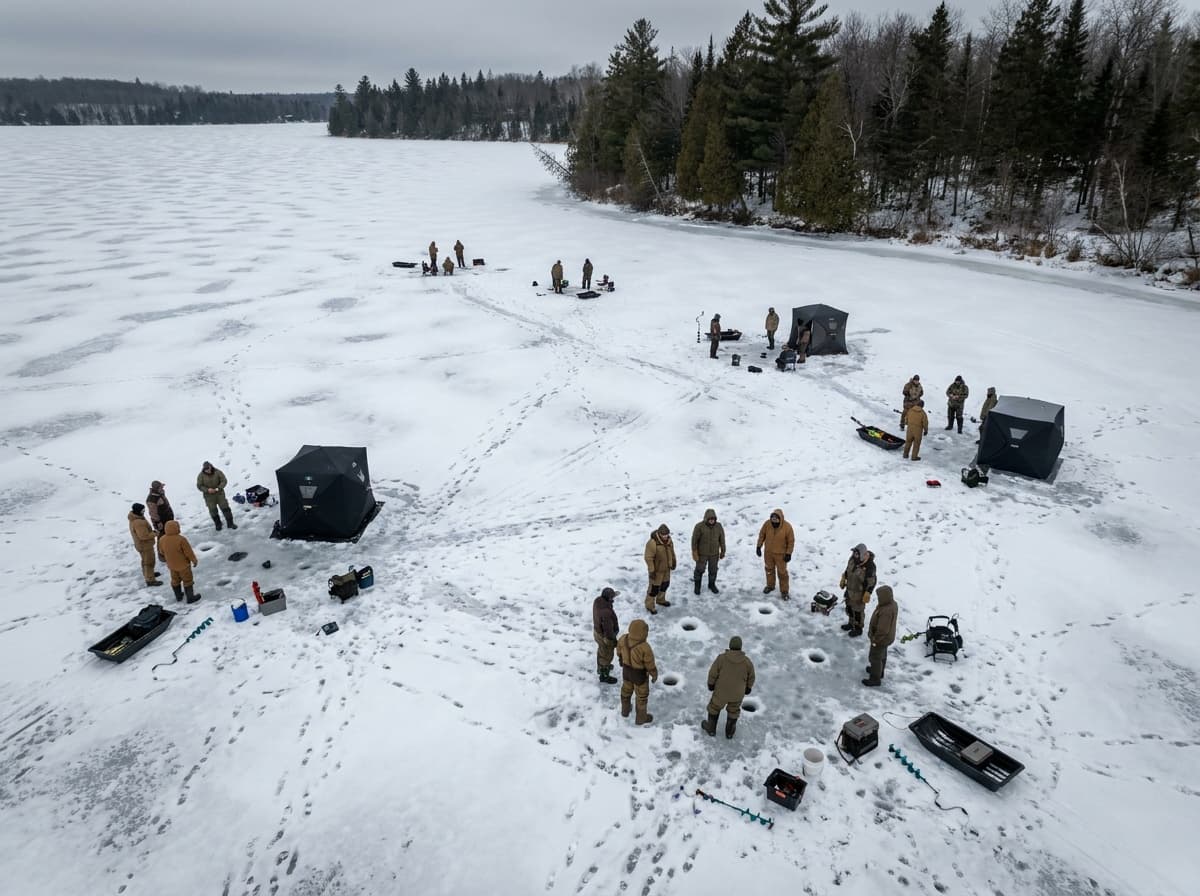
Statistics about fishing are abundant; statistics about fishing that carry their sources are rarer. This page is the second kind. It gathers the current, citable numbers on participation, demographics, economics, and winter safety from named primary sources, updated as new report editions publish. Writers and researchers are welcome to cite this page; the original sources are linked inline and listed at the bottom.
National fishing participation
The benchmark participation series is the annual Special Report on Fishing from the Recreational Boating and Fishing Foundation (RBFF) and the Outdoor Foundation. The 2026 edition, covering the 2025 calendar year, reports:
- 57.0 million Americans ages 6 and up fished in 2025.
- 18 percent of the U.S. population participated.
- 918 million fishing outings were taken in 2025.
- 6.3 million people tried fishing for the first time, accounting for 11 percent of participants.
| Year | Participants (ages 6+) | Source edition |
|---|---|---|
| 2022 | 54.5 million | 2023 Special Report on Fishing |
| 2023 | 57.7 million | 2026 Special Report on Fishing |
| 2024 | 57.9 million | 2026 Special Report on Fishing |
| 2025 | 57.0 million | 2026 Special Report on Fishing |
By water type in 2025, per the same report: nearly 43 million Americans fished freshwater (a 14 percent national participation rate), 15.5 million fished saltwater, and 7.9 million fly fished.
Who is fishing
Demographic detail from the 2026 Special Report on Fishing, covering 2025:
- 21.1 million women fished in 2025, accounting for 37 percent of all participants.
- 6.3 million participants were new to the sport, representing 11 percent of all anglers.
Retention remains the industry's challenge: 19 million people were lost or lapsed participants in 2025, a churn rate of 33 percent, per the same report.
The economics
- More than $230.5 billion in annual economic contribution from sportfishing in the United States, supporting 1.1 million jobs, per the American Sportfishing Association's Sportfishing in America report (2025 edition, produced by Southwick Associates), which counts 57.7 million anglers in its base year of 2023.
- Anglers ages 16 and up spent an average of $2,490 each on fishing-related expenses in 2022, per the USFWS 2022 National Survey.
- Across all wildlife-associated recreation, U.S. residents 16 and up took 1.7 billion trips and spent an estimated $394 billion in 2022 on equipment, travel, and licenses, per the same federal survey as summarized by the Wildlife Management Institute (2023).
- For context, overall outdoor recreation participation reached 183.2 million Americans in 2025, or 59 percent of the population, per the Outdoor Industry Association's current participation data.
The ice fishing picture
Here is an honest data note that most statistics pages skip: no federal survey currently publishes a standalone, annual national count of ice anglers. The participation series above fold hardwater trips into overall fishing. What exists instead is strong state and fishery-level data, and it sketches a robust winter sport:
- More than 13,000 sturgeon spearing licenses were sold for Lake Winnebago's 2023 season, up from roughly 12,000 in 2022, per Wisconsin Public Radio reporting DNR figures (2023). That is a single lake's single specialized winter fishery.
- The Winnebago system's Upriver Lakes spear fishery is capped at 500 licenses issued by lottery, with success rates of 62 percent on the Upriver Lakes versus 9 percent on Lake Winnebago, per the Wisconsin DNR (2026 season page).
- Winnebago's spear fishery has run in its modern form since 1932 and is one of only two places in North America where lake sturgeon may be harvested by spear, alongside Black Lake, Michigan, per the Wisconsin DNR.
- The record speared sturgeon on the system weighed 212.2 pounds (2010), and the oldest on record was aged at 82 years (1953), per WPR citing DNR records.
For the seasonal mechanics behind these numbers, see our guides to how thick ice needs to be and the best times to ice fish, plus live conditions in the Ice & Water Report. The guides library connects the rest of the safety and trip-planning system.
Winter safety statistics
The most complete public dataset on ice safety outcomes is the Minnesota DNR's ice fatality record, running since 1976. The page was marked preliminary as of August 19, 2026 when this article was updated:
| Measure | Figure | Period |
|---|---|---|
| Total ice-related fatalities in Minnesota | 275 | Past 50 years |
| Deadliest recorded season | 22 deaths | 1982-83 |
The DNR identifies machine travel as the largest incident category and notes that most through-the-ice deaths are drownings. Its incident table lists five fatalities attributed to hypothermia. Those findings support the case for worn flotation gear made in our ice fishing safety guide. No ice is ever one hundred percent safe, and Minnesota's own guidance pairs these statistics with its thickness guidelines for new, clear ice.
Sources
- Recreational Boating and Fishing Foundation and Outdoor Foundation, 2026 Special Report on Fishing (2026, covering 2025); 2023 edition (covering 2022)
- American Sportfishing Association and Southwick Associates, Sportfishing in America (2025)
- U.S. Fish and Wildlife Service, 2022 National Survey of Fishing, Hunting, and Wildlife-Associated Recreation (2023)
- Wildlife Management Institute, survey summary (2023)
- Outdoor Industry Association, Participation (2026 data)
- Wisconsin DNR, Winnebago System Sturgeon Spearing (accessed 2026)
- Wisconsin Public Radio, sturgeon spearing license reporting (2023)
- Minnesota DNR, Ice fatality statistics and ice thickness guidelines (fatality page preliminary as of August 19, 2026)
How many people ice fish in the United States?
No federal survey publishes a standalone annual national ice fishing count; hardwater trips are folded into overall fishing participation, which reached 57.0 million Americans in 2025 per the RBFF and Outdoor Foundation. The best available signals are state and fishery-level: a single specialized winter fishery on one Wisconsin lake sold more than 13,000 licenses in 2023. Treat any precise national ice angler figure you encounter without a named survey behind it as an estimate.
Is fishing participation growing or shrinking?
The latest year moved down slightly from 57.9 million participants in 2024 to 57.0 million in 2025, while remaining above 54.5 million in 2022. Retention is a continuing challenge: the 2026 report counted 19 million lost or lapsed participants and 6.3 million first-time participants in 2025.
What is ice fishing's economic impact?
No national study isolates ice fishing's slice, so the citable frame is sportfishing overall: more than $230.5 billion in annual U.S. economic contribution and 1.1 million jobs per the American Sportfishing Association. Winter-specific spending shows up in state-level events and license data, like Winnebago's 13,000-plus spearing licenses, and in the ice-specific gear, shelter, and travel economy that general fishing surveys fold into their totals.
Are ice fishing deaths increasing?
The Minnesota DNR's preliminary record does not support a simple national trend claim. Its page lists 275 fatalities over the past 50 years and shows large year-to-year variation, including a high of 22 deaths in 1982-83. Machine travel is the largest incident category, and drowning is the dominant cause, which is why guidance centers worn flotation and why no ice is ever one hundred percent safe.