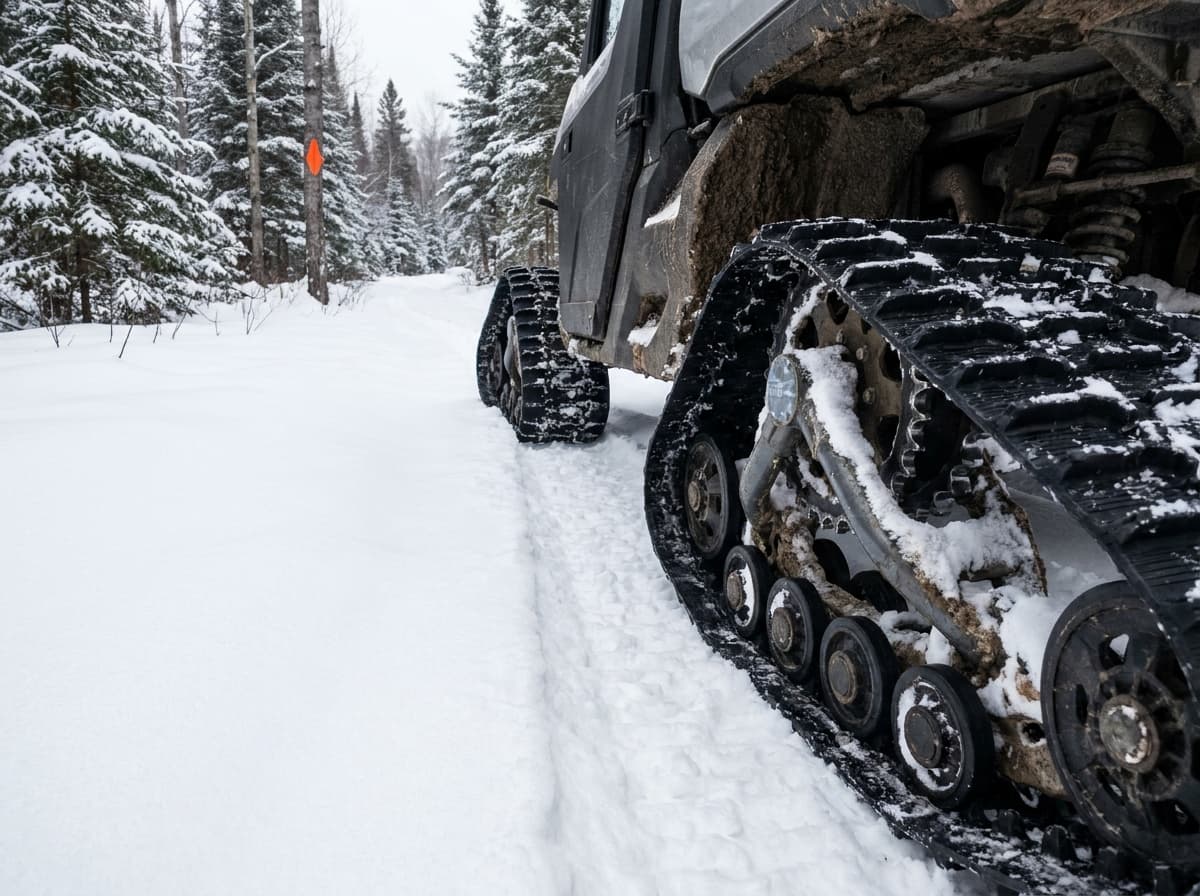
A track conversion turns a wheeled machine into something closer to a small snowcat. Each corner gets a triangular rubber track that spreads the machine's weight over a much larger footprint, which is what lets a UTV stay on top of deep snow, mud, and swamp instead of sinking and digging in. For a late-season hunter checking trap lines, running a plow route, or reaching a stand across a drifted field, that flotation is the whole point. It is also why tracks are not a casual accessory: they change the machine's gearing, speed, handling, and fuel use, and they cost as much as a good used vehicle.
What tracks actually buy you
The honest tradeoff is flotation and grip in exchange for money, speed, and simplicity. On deep unpacked snow or saturated ground where tires would bury to the axle, a well matched track system keeps moving. In return you accept lower top speed, heavier steering, higher fuel burn, more strain on the drivetrain, and a real installation and storage commitment twice a year. On hard packed trails or bare ground, tracks are slower and wear faster than tires, so most owners run them only for the season that justifies them.
Why we do not list track kits as retail picks
Genuine UTV track systems from the established makers are fitment engineered to a specific chassis and sold through dealers who confirm compatibility, handle mounting, and stand behind the fit. They are not reliably available as correct, model matched listings on the general retail channels we link elsewhere on this site, and the results that do appear under a "UTV tracks" search are usually recovery boards or unrelated parts. Rather than point you at a mismatched listing to earn a click, we would rather tell you plainly: buy tracks through a powersports dealer who will verify the kit against your exact machine. That is the version of this category that protects your money.
The main track makers to research
Camso, now part of the Michelin group, is the dominant name and offers lines aimed at different priorities, from lighter utility kits to heavier all terrain systems. Kimpex sells the Commander track line as a value oriented option. Mattracks and Soucy build heavier duty and specialized systems. Machine manufacturers such as Polaris, Can-Am, and others also offer or endorse factory track kits engineered for their own chassis, which is often the cleanest path to a guaranteed fit. Start from your machine's make, model, and year, then ask which kits are validated for it.
What to evaluate before buying
Confirm the kit is validated for your exact make, model, and year, including any mid year drivetrain changes. Ask about the recommended gear reduction kit, since most conversions want lower gearing to protect the drivetrain and restore usable power. Budget for the full picture, not just the tracks: gearing, install labor, and seasonal swap time. Consider where you will store a set of tires and a set of tracks, and whether you can do the twice yearly swap yourself or will pay a dealer. Finally, match the track line to your real terrain, since a deep snow flotation system and a mud and trail system are tuned differently.
Sizing a track system to the machine
Track sizing is not a matter of picking a width off a shelf. Each system is matched to the machine's weight, wheelbase, hub pattern, and brake package, and the makers publish separate lines for lighter recreational side by sides and for heavy utility machines carrying a plow, a loaded bed, and two occupants. The number that governs flotation is ground pressure, which falls as total track footprint grows, so a longer and wider track floats better while adding unsprung weight and steering effort. Confirm three physical fits before anything else. The sprocket hub adapter has to match your wheel bolt pattern and hub bore, the front units need clearance at full steering lock and full suspension travel, and the anti-rotation arms have to anchor to a frame or A-arm point the kit was designed around. Adding a winch, a plow, or a heavy bed load shifts weight forward and can change which line the maker recommends, so describe your real setup to the dealer rather than the base model.
Install, seasonal swaps, and storage
A first fit is a shop job, not an afternoon. The initial install covers mounting hub adapters, setting anti-rotation hardware, verifying clearances, and often installing a gear reduction kit, which usually means opening the front and rear differentials. Once the adapters are on and the setup is proven, a seasonal swap becomes more approachable, but plan on a couple of hours with a proper jack or lift and a second set of hands, since each track unit is a bulky assembly in the range of 100 to 150 pounds and awkward to lift alone. A low cart or a furniture dolly makes the swap much easier on your back. Storage is the part owners underestimate. You now own two complete sets of running gear, and the tracks need dry space where they can sit without the rubber taking a set. Torque every fastener to the kit's spec at install, then recheck after the first few hours of running.
Drivetrain, gearing, and how the machine drives
Tracks change a machine's character more than any other accessory. The effective rolling diameter and the drag of four rubber belts raise the load on the drivetrain, which is why makers recommend a lower final drive. Without one, the CVT belt runs hotter, the engine spends more time outside its efficient range, and clutch and belt wear climb. Expect top speed to settle somewhere in the 25 to 35 mph range depending on the kit, fuel burn to rise noticeably, and the turning radius to widen. Steering effort goes up too, which is a genuine consideration on a machine without power steering and for anyone managing wrist or shoulder limits. Braking changes as well, since the system adds rotating mass and grips packed snow differently than a tire does. None of that is a defect. It is the price of flotation, and it is why most owners run tracks for one season and swap back.
Keeping a track system healthy
Maintenance here is mostly attention rather than labor. Check track tension against the maker's spec early in the season and again once the belts have settled, since a loose track can derail in deep snow and an overtightened one loads the bogie wheel bearings. Those idler and bogie bearings are the usual wear item, so spin each wheel by hand at every swap and listen for roughness. Ice and packed snow build up between the wheels and the belt, so knock that buildup loose before it refreezes into a solid mass, and rinse grit off after wet-ground runs so it does not grind into the bearings. Rubber lugs wear fastest on pavement and frozen gravel, which is a good argument for trailering to the trailhead. At the end of the season, clean the units, let them dry, and store them out of direct sun.
When tires or chains are the smarter buy
Most winter traction problems are not flotation problems. If you are fighting ice, packed snow, or slick trails rather than sinking into unpacked powder, a good set of aggressive tires or a set of tire chains will get you there for a small fraction of a track budget. Our UTV tires and wheels guide covers the tread and sizing choices, and the UTV winter prep checklist walks through the rest of a cold season setup. If plowing is the job, the UTV snow plows guide covers the front of the machine. The UTV hub covers the less specialized alternatives.
How much do UTV tracks cost?
Complete track systems from the established makers generally run from roughly two thousand dollars on the low end to five thousand or more for heavier duty and specialized kits, before install labor and any gearing changes. Factory endorsed kits sit in a similar range. Treat the tracks themselves as one line item in a larger budget that also includes gear reduction and seasonal swaps.
Do I need a gear reduction kit with tracks?
Usually yes. Tracks change the effective gearing and add rolling resistance, so most manufacturers recommend a lower final drive to protect the drivetrain and keep usable power and reasonable speed. Ask the dealer which reduction kit is matched to your machine and chosen track line before you commit.
Are tracks better than tires for winter?
Only for the right problem. Tracks win decisively in deep, unpacked snow and soft saturated ground where tires would sink. For ice, packed snow, and firm trails, quality winter tires or chains give better speed, lower cost, and less drivetrain strain. Match the tool to the terrain you actually cross most days.
Can I install a track system myself?
Some experienced owners do their own swaps, but first fit and validation are best handled by a dealer who confirms the kit matches your machine and sets it up correctly. Once a system is dialed in, seasonal swaps between tires and tracks are more approachable at home if you have the space, tools, and time.