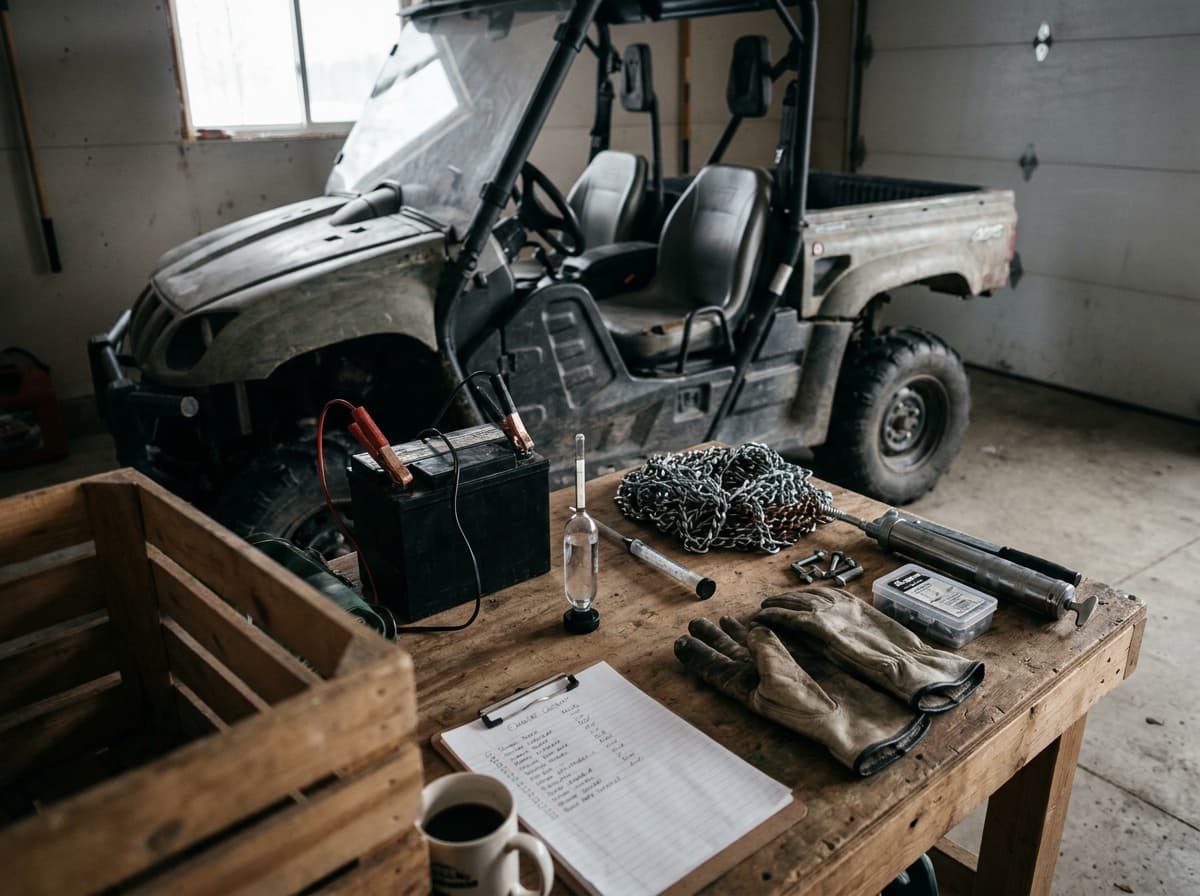
A side-by-side is one of the most useful machines on a rural property in winter, whether you are plowing a driveway, checking a trapline, or hauling gear across snow. But cold weather is hard on equipment, and a little preparation prevents most of the failures that leave a UTV dead in the coldest, least convenient moment. The right checklist depends on whether the machine will run all winter or sleep until spring.
First decide: run it or store it
Everything below sorts into two buckets. A working winter UTV needs reliable starting, freeze protection, and traction. A stored UTV needs protection against fuel, moisture, pests, and flat-spotted tires. Some steps overlap, but doing the wrong list for your situation wastes effort, so start by deciding which machine you have.
Battery: cold saps starting power
Batteries lose cranking capacity as temperatures fall, so winter is when a marginal battery finally quits. For a machine you will keep using, test the battery before the cold sets in and keep it topped up, ideally on a compatible maintenance charger between uses. For a machine going into storage, Polaris recommends removing the battery, cleaning the terminals so they make the best connection in spring, and maintaining its charge over the layoff. Store a removed battery somewhere cool and dry rather than on a concrete floor, and keep it on a tender if your charger supports the battery chemistry.
Coolant and fluids
Liquid-cooled UTVs rely on coolant that both prevents freezing and resists boiling. For a machine that will work through winter, verify that the coolant provides freeze protection well below the coldest temperatures you expect, and check the owner's manual for the correct type and mixture. Coolant that is old or diluted can lose its protection rating and should be serviced.
Fluids matter for storage too. Polaris advises changing the oil before a machine goes into winter storage, since the acidic combustion byproducts that accumulate in used oil can damage internal parts over a long idle period, and it extends the same logic to transmission and differential fluids. Fresh oil in, then storage, is the order.
Traction: tracks, chains, and snow tires
Getting a UTV to move in snow is its own discipline, and there is no single best answer. Snow accessory overviews such as Partzilla's guide describe the main options: track systems, tire chains, and dedicated winter tires.
| Option | Strength | Trade-off |
|---|---|---|
| Track systems | Excellent flotation and traction in deep snow, working like snowmobile tracks | Higher cost and installation effort; can handle worse than tires on pure ice |
| Tire chains | Strong bite on packed snow and ice, lower cost | Best at moderate speeds; not for deep, unpacked snow |
| Winter and studded tires | Simpler than tracks, better ice grip than standard tires | Less flotation than tracks in deep powder |
The practical read is to match the tool to your terrain: tracks for deep-snow country, chains or dedicated snow tires for packed trails, driveways, and ice. Whatever you choose, reduce speed and expect different braking and handling than in summer.
Mounting a plow
If plowing is the job, the plow setup is as important as the machine. Confirm the plow system, the frame mount, push tube, and blade, is rated for your specific model and front end. Add ballast, weight low and to the rear, to keep the machine planted when the blade is loaded, and set the correct tire pressure for traction. Adjust the blade angle for the surface, and use skid shoes to protect gravel or pavement and to keep the blade from digging in. Verify the lift system, whether a winch or a dedicated actuator, raises and holds the blade reliably before the first storm.
Storing a UTV for winter
For a machine that will sit until spring, Polaris lays out a clear routine:
- Follow the exact fuel-storage procedure in the owner's manual. Fuel systems, approved stabilizers, tank-level instructions, and carburetor procedures vary by make and model. Do not combine a drain procedure from one machine with a stabilize-and-fill procedure from another. The linked Polaris guidance applies to covered Polaris models; use your manufacturer's current instructions and product doses.
- Change the oil and other fluids before storage, as above.
- Service the air filter and block the airbox intake, plus other intakes and exhaust openings, to keep rodents from nesting inside.
- Remove and maintain the battery.
- Clean and protect the body. Wash off dirt and mud, which can hold moisture and promote corrosion, and apply a protective wax.
- Cover it, ideally indoors, with a proper cover rather than a bare tarp.
- Elevate it on jack stands or blocks to take weight off the tires and prevent flat spots over a long idle.
Winter prep is about matching effort to use. A working plow rig and a hibernating trail machine need different things, but both reward a checklist done before the first hard freeze. For more model-specific setups and gear, see the UTV, ATV and dirt bike hub.
Should I use tracks or chains on my UTV in winter?
It depends on terrain. Track systems give the best flotation and traction in deep snow but can handle worse than tires on pure ice and cost more to buy and install. Chains and dedicated winter or studded tires bite well on packed snow and ice at moderate speeds and cost less. Deep-snow country favors tracks; packed trails, driveways, and ice favor chains or snow tires.
How do I store a UTV for the winter?
Follow the current owner's manual for your exact model. Fuel-storage procedures can require stabilization, draining, or other model-specific steps, so do not treat them as interchangeable. Service fluids, intake protection, battery care, cleaning, covering, and tire-load procedures should also follow the manufacturer's sequence and support-point instructions. The linked Polaris routine applies only where it matches the machine.
Do I need to worry about coolant in a UTV in winter?
Yes, on liquid-cooled machines. Coolant must provide freeze protection below the coldest temperatures you expect and resist boiling under load, such as when plowing. Check the owner's manual for the correct type and mixture, and service coolant that is old or diluted. A stored machine still benefits from coolant in good condition rather than degraded fluid.
Sources
- Polaris, How to Winterize Your ATV or SxS/UTV
- Partzilla, 8 Essential ATV-UTV Snow Accessories