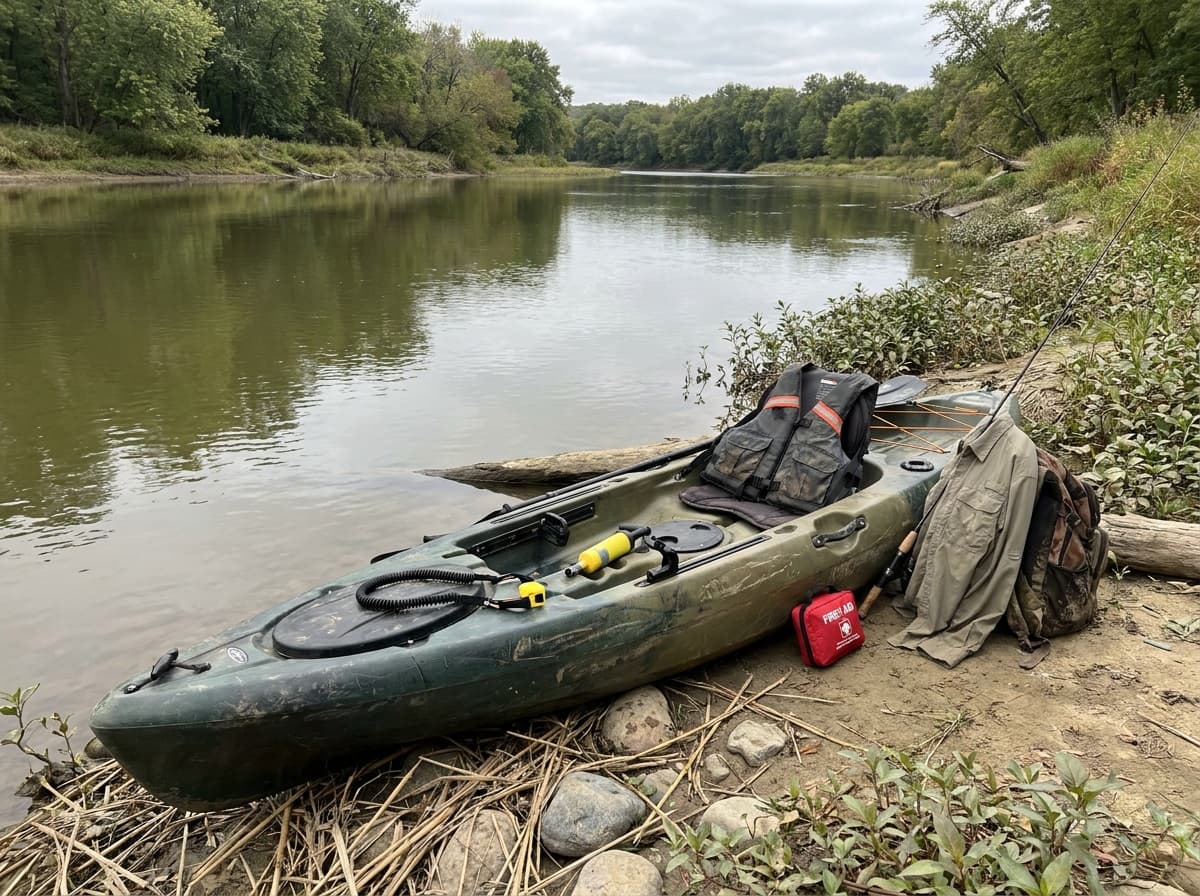
Fishing kayaks put anglers into skinny water, tight cover, and quiet spots that boats cannot reach, which is exactly why they have exploded in popularity. They are also small, low, and easy to flip, and they are boats in the eyes of safety regulators. The good news is that the fatal risks are few and well understood, and the habits that address them are cheap and learnable.
Wear the life jacket, every time
The most consequential safety choice in any small craft is the one you make at the ramp. In its 2024 Recreational Boating Statistics, the US Coast Guard reported that where the cause of death was known, 76 percent of fatal boating accident victims drowned, and of those drowning victims whose life jacket status was known, 87 percent were not wearing one. The American Canoe Association's Best Practices for Paddlers states the principle plainly: being safe on the water always starts with wearing your lifejacket, and you should not stand up in a canoe or kayak.
A life jacket only works if it is on your body. Stowing it under the seat, where it cannot help during a sudden capsize, is functionally the same as leaving it home. Inflatable and low-profile fishing PFDs are comfortable enough to wear all day, which is the entire point.
Cold water is the real hazard
Air temperature lies. A warm, sunny day can sit over water cold enough to incapacitate you in minutes, and paddlers who dress for the air rather than the water are the ones who get in trouble. The National Center for Cold Water Safety describes what happens when cold water hits your skin: cold shock causes an immediate loss of breathing control, including gasping and hyperventilation, and this reaches maximum intensity between 50 and 60 degrees Fahrenheit. It is a leading cause of sudden drowning, and it strikes before hypothermia is even a factor.
The danger unfolds in stages. First comes cold shock and the loss of breathing control in the opening minute. Next, over the following minutes, cold saps strength and dexterity in the arms and hands, so swimming and self-rescue become progressively harder. Only later does hypothermia set in. The practical response is to dress for immersion. A cold-water paddling resource from the American Canoe Association and partners advises that when water temperature is 60 degrees Fahrenheit or colder, a wetsuit is a must and a drysuit is highly recommended.
Cold-water season also overlaps with early and late ice on many northern lakes. No frozen surface is ever safe to assume, and a fishing kayak has no business testing questionable ice; treat the shoulder seasons as cold-water immersion risk and dress accordingly.
Self-rescue: practice before you need it
Capsizing is not the emergency. Being unable to get back in the boat is. The time to learn re-entry is on a warm day in shallow water, wearing what you will actually fish in, not during a real capsize in cold water far from shore.
- Stay with your boat. A kayak floats and is far easier to spot than a swimmer. In wind, it can also drift faster than you can swim, so hold on.
- Practice a re-entry method. A paddle-float re-entry or a deep-water scramble back onto a sit-on-top should be rehearsed until it is reliable. Know how your specific kayak behaves when swamped.
- Carry signaling and communication. A whistle attached to your PFD, a waterproof light for low visibility, and a phone in a waterproof case or a VHF radio let you call for help. The Coast Guard requires a sound-signaling device on board.
- Leave a float plan. Tell someone where you are launching, your route, and when you will be back. It is the single cheapest piece of safety gear that exists.
Before you launch
A short pre-launch routine catches most problems on shore, where they are harmless.
| Check | Why it matters |
|---|---|
| Life jacket on and zipped | 87 percent of known boating drowning victims were not wearing one |
| Dressed for water temp | Cold shock and swim failure strike long before hypothermia |
| Weather and wind checked | Wind and waves, not depth, flip most fishing kayaks |
| Whistle, light, phone secured | You cannot signal with gear you cannot reach |
| Float plan shared | Speeds rescue if you do not return on time |
| No alcohol | The Coast Guard lists alcohol as a leading known contributing factor in fatal boating accidents |
With the safety pieces handled, the fishing itself is the fun part. Once you are on the water, our guides to walleye fishing and bluegill and crappie, along with the rest of the fishing hub, cover how to catch fish from a kayak or any small craft.
Do I really need a life jacket in a fishing kayak?
Yes. A kayak is legally a vessel, and Coast Guard data shows the overwhelming majority of boating drowning victims were not wearing a life jacket. Modern fishing PFDs are low-profile and comfortable enough to wear all day. Worn, not stowed, is what counts, because a sudden capsize gives you no time to put one on.
How cold is too cold to kayak fish?
There is no single cutoff, but the National Center for Cold Water Safety warns that cold shock peaks between 50 and 60 degrees Fahrenheit, and paddling guidance recommends a wetsuit or drysuit once water is 60 degrees or colder. Dress for the water temperature, not the air, and treat early spring, late fall, and near-ice conditions as serious immersion risk.
What should I do if my kayak flips in cold water?
Control your breathing through the first minute of cold shock, stay with your boat because it floats and is easier to see, and use a practiced re-entry method to get back on or in. Signal for help with the whistle and light on your PFD. Because cold quickly weakens your muscles, rehearse self-rescue in warm, shallow water first.
Sources
- US Coast Guard, 2024 Recreational Boating Statistics
- American Canoe Association, Best Practices for Paddlers and Paddlesport Programs
- American Canoe Association and partners, Cold Water Survival
- National Center for Cold Water Safety, Why Cold Water Is Dangerous