A spotting scope is the optic that turns "there is a deer" into "that is a legal buck at 800 yards," which is why glass quality at first and last light matters more than raw magnification here. The specs that decide a hunt are objective size, resolution across the zoom range, carry weight, and how well the housing survives weather and packs. Price bands below run from under $150 to just under $600, and each tier buys a real, visible improvement. This guide covers optics and accessories only. Sportsman Authority does not sell or link firearms or ammunition.
Best all-around spotter: Vortex Diamondback HD 20-60x85
The Diamondback HD 85 is the spotter most hunters should buy first. Its 85 mm objective gathers enough light to read antler detail in the last minutes of shooting light, the HD glass controls color fringing far better than its price suggests, and the argon-purged housing is waterproof and fogproof. Vortex's VIP warranty covers damage with no receipt, which matters for glass that rides in a pack. The honest tradeoffs: it is a heavy full-size body for long backcountry pack-ins, and true alpha spotters still pull ahead in the final minutes of dusk.
Best all-around spotter
Vortex · Spotting Scopes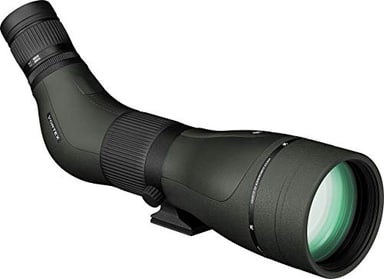
Vortex Diamondback HD 20-60x85 Spotting Scope
The default do-everything hunting spotter: 85 mm objective stays bright at legal light. The main tradeoff is full-size 85 mm body is heavy for long backcountry pack-ins.
Best for: The hunter who wants one full-size spotter to read antler detail and count points across a canyon.
View product details- Price band
- $250–$500
- Authority Score
- 8.7 / 10
- Configuration
- 20-60x zoom, 85 mm objective, angled body
- Glass
- HD extra-low dispersion, fully multi-coated
- Build
- Argon-purged, waterproof and fogproof
Why it works
- The default do-everything hunting spotter: 85 mm objective stays bright at legal light
- HD glass controls color fringing far better than the price suggests
- VIP warranty covers damage with no receipt, which matters for glass that rides in a pack
Watch for
- Full-size 85 mm body is heavy for long backcountry pack-ins
- Alpha spotters still pull ahead in the last five minutes of shooting light
Best backcountry spotter: Vortex Diamondback HD 16-48x65
For hunters who count ounces, the 65 mm Diamondback HD drops real weight while keeping the same HD glass and VIP warranty as its big brother. The smaller body packs down for spot-and-stalk and horseback hunts, and the Arca-Swiss compatible foot mounts straight to modern tripod heads. The tradeoffs are physics: a 65 mm objective gathers less light than an 85 mm at dawn and dusk, and the 48x top end trails the 60x of full-size scopes.
Best backcountry spotter
Vortex · Spotting ScopesVortex Diamondback HD 16-48x65 Spotting Scope
The 65 mm body drops real weight for backpack and western hunts. The main tradeoff is smaller objective gathers less light than an 85 mm at dawn and dusk.
Best for: The mobile hunter who counts ounces and wants HD glass that still packs down small.
View product details- Price band
- $250–$500
- Authority Score
- 8.5 / 10
- Configuration
- 16-48x zoom, 65 mm objective, angled body
- Glass
- HD extra-low dispersion, fully multi-coated
- Build
- Argon-purged, waterproof and fogproof
Why it works
- The 65 mm body drops real weight for backpack and western hunts
- Same HD glass and VIP warranty as the 85 mm at lower carry cost
- Arca-Swiss foot mounts straight to modern tripod heads
Watch for
- Smaller objective gathers less light than an 85 mm at dawn and dusk
- Top-end 48x magnification trails the 60x of full-size spotters
Best full-size value: Athlon Optics Argos HD 20-60x85
The Argos HD 85 answers a specific want: a full-size 85 mm objective near the bottom of the serious-spotter price range. Argon purging and rubber armor handle rough field use, the 60x top end reaches out for detail, and Athlon's lifetime warranty backs the value. Its standard multi-coatings trail the ED and HD glass in pricier scopes, and like any 85 mm body it is heavier than a compact 65 mm, but for aperture per dollar it is hard to beat.
Best full-size value
Athlon · Spotting Scopes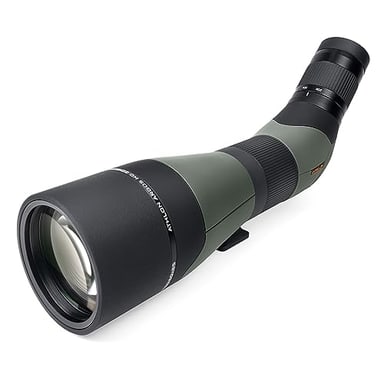
Athlon Optics Argos HD 20-60x85 Spotting Scope
Delivers a full-size 85 mm objective near the bottom of the serious-spotter price range. The main tradeoff is standard multi-coatings trail the ED and HD glass in pricier spotters.
Best for: The value-focused hunter who wants full-size aperture without stepping into alpha pricing.
View product details- Price band
- $250–$500
- Authority Score
- 8.3 / 10
- Configuration
- 20-60x zoom, 85 mm objective, 45 degree angled
- Glass
- Advanced fully multi-coated with phase-corrected prisms
- Build
- Argon-purged, waterproof and fogproof, rubber armor
Why it works
- Delivers a full-size 85 mm objective near the bottom of the serious-spotter price range
- Argon purge and rubber armor handle rough field use
- Athlon lifetime warranty backs the value pick
Watch for
- Standard multi-coatings trail the ED and HD glass in pricier spotters
- Heavier than compact 65 mm bodies for backcountry carry
Best ready-to-glass kit: Athlon Optics Talos 20-60x80
The Talos 80 ships with a compact tripod and carrying case, so it is a complete glassing setup out of the box at an entry price. The 80 mm objective and 60x top end punch above what you pay, and the waterproof, rubber-armored body handles field life. Set expectations on the extras: the bundled tripod is a starter unit rather than a stable long-range base, and the image softens toward the top of the zoom range.
Best ready-to-glass kit
Athlon · Spotting Scopes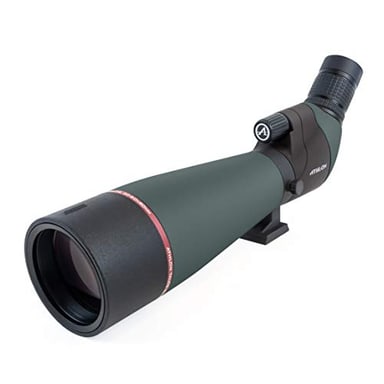
Athlon Optics Talos 20-60x80 Spotting Scope
Includes a tripod and case, so it is a complete glassing setup out of the box. The main tradeoff is bundled tripod is a starter unit, not a stable long-range base.
Best for: The first-time spotter buyer who wants a ready-to-glass kit at an entry price.
View product details- Price band
- $150–$250
- Authority Score
- 7.9 / 10
- Configuration
- 20-60x zoom, 80 mm objective, angled body
- Bundle
- Ships with compact table tripod and carrying case
- Build
- Fully multi-coated, waterproof and fogproof, rubber armor
Why it works
- Includes a tripod and case, so it is a complete glassing setup out of the box
- 80 mm objective and 60x top end punch above the entry price
- Lifetime warranty rare at this tier
Watch for
- Bundled tripod is a starter unit, not a stable long-range base
- Image softens toward the top of the zoom range
Best crossover pick: Celestron Ultima 80 Angled
The Ultima 80 is a long-running favorite for hunters who also bird and shoot targets. Its 80 mm objective and multi-coated optics deliver bright all-day images, and the built-in T-adapter makes digiscoping scouting photos simple. Two things to know: the older optical design shows more edge softness than newer HD glass, and no tripod is included, so budget for a stable base.
Best crossover pick
Celestron · Spotting Scopes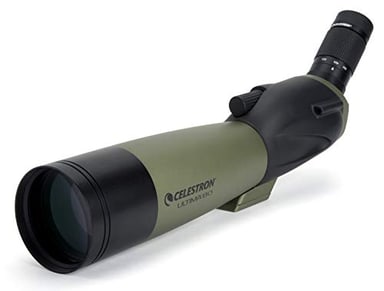
Celestron Ultima 80 Angled Spotting Scope
Long-running crossover favorite for hunters who also bird and target shoot. The main tradeoff is older optical design shows more edge softness than newer HD glass.
Best for: The mixed-use glasser who wants a proven 80 mm scope for hunting, birding, and the range.
View product details- Price band
- $150–$250
- Authority Score
- 8.1 / 10
- Configuration
- 20-60x zoom, 80 mm objective, 45 degree angled
- Glass
- Multi-coated optics, BaK-4 prisms
- Build
- Waterproof with protective rubber armor
Why it works
- Long-running crossover favorite for hunters who also bird and target shoot
- Built-in T-adapter makes digiscoping simple for scouting photos
- Widely available with a deep accessory ecosystem
Watch for
- Older optical design shows more edge softness than newer HD glass
- No tripod included, so budget for a stable base
Best lightweight weatherproof: Bushnell Trophy Xtreme 20-60x65
The Trophy Xtreme 65 keeps pack weight down for spot-and-stalk hunts while staying fully sealed against weather. The rubber-armored, waterproof, fogproof housing shrugs off knocks and rain, and Bushnell's Ironclad warranty backs the mid-budget price. The 65 mm aperture is dimmer than an 80 mm at last light, and the accessories feel basic next to the optics, but the carry weight is the point.
Best lightweight weatherproof
Bushnell · Spotting Scopes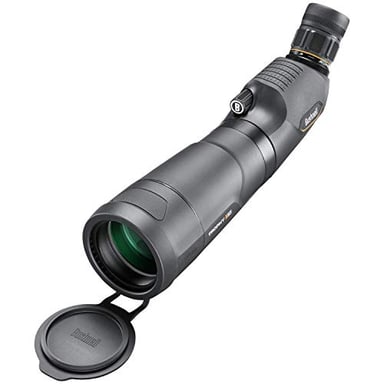
Bushnell Trophy Xtreme 20-60x65 Spotting Scope
Compact 65 mm body keeps pack weight down for spot-and-stalk hunts. The main tradeoff is 65 mm aperture is dimmer than 80 mm scopes at last light.
Best for: The western hunter who wants a light, weatherproof spotter for glassing on the move.
View product details- Price band
- $150–$250
- Authority Score
- 8.0 / 10
- Configuration
- 20-60x zoom, 65 mm objective, 45 degree angled
- Glass
- Multi-coated optics
- Build
- Waterproof, fogproof, rubber-armored housing
Why it works
- Compact 65 mm body keeps pack weight down for spot-and-stalk hunts
- Rubber armor and sealed housing shrug off weather and knocks
- Ironclad warranty backs the mid-budget price
Watch for
- 65 mm aperture is dimmer than 80 mm scopes at last light
- Accessories and case feel basic next to the optics
Best bare-budget spotter: Gosky 20-60x80
The Gosky 80 puts an 80 mm objective and a phone adapter in reach at a bare-budget price. The dual-focus wheel speeds coarse and fine adjustment, the housing is waterproof and fogproof, and the included phone mount turns it into an easy scouting and record camera. Its image quality and low-light performance trail name-brand glass, and no standing tripod is included, but as a first spotter or a truck-cab backup it earns its place.
Best bare-budget spotter
Gosky · Spotting Scopes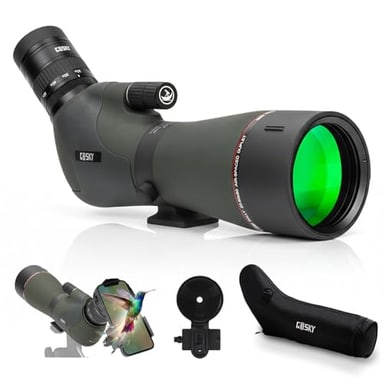
Gosky 20-60x80 Spotting Scope
Puts an 80 mm objective and phone adapter in reach at a bare-budget price. The main tradeoff is image quality and low-light performance trail name-brand glass.
Best for: The buyer who wants an 80 mm spotter and phone-scoping on the tightest budget.
View product details- Price band
- $100–$150
- Authority Score
- 7.3 / 10
- Configuration
- 20-60x zoom, 80 mm objective, angled body
- Glass
- BaK-4 prism, fully multi-coated optics, dual-focus
- Build
- Waterproof, fogproof, rubber armor
Why it works
- Puts an 80 mm objective and phone adapter in reach at a bare-budget price
- Dual-focus wheel speeds coarse and fine adjustment
- Included phone adapter makes it an easy scouting and record camera
Watch for
- Image quality and low-light performance trail name-brand glass
- No standing tripod included at this price
Fit, sizing, and handling
A spotter is only as good as the tripod under it and the eye behind it. Eyeglass wearers should confirm usable eye relief with the cups down, and every buyer should match the scope to a tripod rated for its weight, since a shaky base erases the benefit of good glass. Angled bodies suit sharing and steep uphill glassing, while straight bodies are faster to point from a truck window. Consider carry weight honestly against how far you actually walk before first light.
How we picked
We compared published specifications and cited independent coverage, weighting four criteria: resolution at legal shooting light, objective size and brightness, carry weight, and warranty strength. Once your spotter is settled, pair it with a unit from our best hunting binoculars roundup and a laser from our best rangefinders guide, then browse the rest of the hunting hub for the gear around it.
How much magnification do I actually need in a spotting scope?
For most big-game hunting, a 20-60x zoom on a 65 to 85 mm objective covers the job. You will spend most of your time in the 20-40x range, where the image is brightest and steadiest, and reach for 60x only in calm conditions to confirm detail. Beyond about 40x, heat shimmer and any tripod shake become the limit, not the glass.
Is an 85 mm objective worth the extra weight over a 65 mm?
It depends on how you hunt. An 85 mm objective gathers noticeably more light in the first and last minutes of legal shooting light, which is when game moves. If you glass from a truck, a stand, or a short walk, the bigger objective is worth it. If you pack miles before dawn, the weight savings of a 65 mm body often wins.
Do I need to buy a tripod separately?
Usually, yes. Most quality spotters ship without a tripod, and the Athlon Talos here is the exception with a starter tripod in the box. Budget for a tripod rated to hold the scope's weight steady, because a shaky base erases the resolution you paid for. Angled scopes pair well with lighter tripods since the eyepiece sits lower.
Angled or straight body for hunting?
Angled bodies are easier to share, more comfortable for steep uphill glassing, and let you run a shorter, lighter tripod. Straight bodies are faster to point at a target and simpler to use from a truck window or a prone position. Most western glassers prefer angled; many treestand and vehicle hunters prefer straight.