A marine battery choice comes down to chemistry, capacity, and physical fit. Chemistry is the big fork: AGM is heavy, cheap, and proven, but you can safely use only about half its rated capacity, while LiFePO4 lithium is light, delivers its full rated capacity, and lasts far more cycles, at a higher upfront price. Capacity, measured in amp hours, sets your runtime, and group size sets whether the battery drops into your boat's tray and whether the terminals match your leads. We picked across both chemistries and a real price range, and we call out group size and the AGM versus lithium tradeoff for each. Match the battery to your motor's voltage and your tray before you buy.
Best value AGM: Weize 12V 100Ah
The Weize 100Ah is the popular budget path to a full-size trolling motor battery: a maintenance-free, leak-proof AGM in a standard Group 31 case that drops into most trays. It delivers a strong price per amp hour and is a sensible first deep-cycle battery. The tradeoffs are inherent to lead-acid: it weighs more than 60 lb, and for battery health you should use only about half the 100Ah before recharging, so usable capacity is closer to 50Ah.
Best value AGM
Weize · Marine Batteries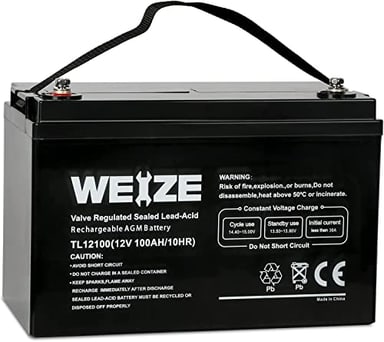
WEIZE 12V 100Ah Deep Cycle AGM Battery, Group 31
Popular value AGM at a low price per amp hour. The main tradeoff is weighs more than 60 lb.
Best for: Budget-conscious trolling motor or house power use where weight is not critical.
View product details- Price band
- $150–$250
- Authority Score
- 8.0 / 10
- Chemistry
- AGM lead-acid
- Capacity
- 100Ah
- Group size
- 31
Why it works
- Popular value AGM at a low price per amp hour
- Maintenance-free and leak-proof
- Standard Group 31 fit for most trolling motor trays
Watch for
- Weighs more than 60 lb
- Usable capacity is roughly half at a safe depth of discharge, like all lead-acid
Best all-purpose AGM: Universal Power Group UB121000
The UPG UB121000 is a long-standing, widely stocked 100Ah AGM that shows up in trolling motor, solar, and accessory setups alike. It is vibration and shock resistant with UL-recognized cells, which is reassuring for a battery that lives in a bouncing boat. Two things to note: it weighs about 63 lb like other lead-acid 100Ah batteries, and its button terminals may need adapters to fit some trolling motor leads, so check your connectors.
Best all-purpose AGM
Universal Power Group · Marine Batteries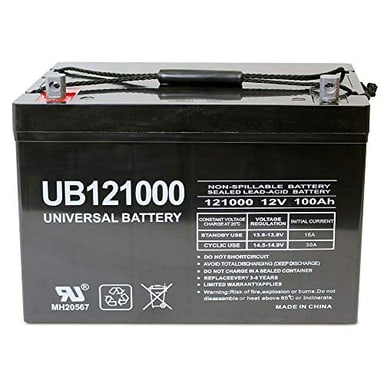
Universal Power Group UB121000 12V 100Ah AGM SLA Deep Cycle Battery
Long-standing and widely stocked. The main tradeoff is heavy at more than 60 lb.
Best for: A dependable all-purpose AGM for trolling motors, solar, and marine accessories.
View product details- Price band
- $150–$250
- Authority Score
- 8.0 / 10
- Chemistry
- AGM VRLA lead-acid
- Capacity
- 100Ah
- Group size
- 27
Why it works
- Long-standing and widely stocked
- Vibration and shock resistant
- UL-recognized cells
Watch for
- Heavy at more than 60 lb
- Button terminals may need adapters for some trolling motor leads
Best name-brand AGM: Renogy Deep Cycle 12V 100Ah
Renogy is a trusted name in solar and marine power, and this maintenance-free 100Ah AGM carries that reputation with good vibration tolerance for boat use. If you want a recognized brand behind a lead-acid battery, this is the pick. The tradeoffs are weight, at about 66 lb, and price that swings with frequent sales and backorders, so it pays to watch the listing rather than buy on a spike.
Best name-brand AGM
Renogy · Marine Batteries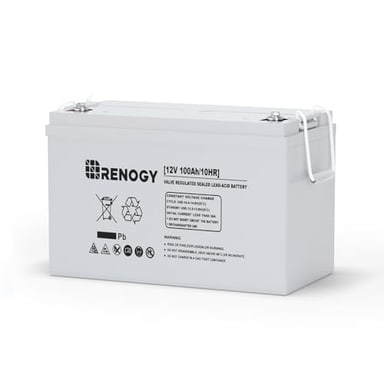
Renogy Deep Cycle AGM 12 Volt 100Ah Battery
Trusted solar and marine brand. The main tradeoff is heavy at about 66 lb.
Best for: Marine and solar hybrid setups where you want a name-brand AGM.
View product details- Price band
- $150–$250
- Authority Score
- 7.8 / 10
- Chemistry
- AGM lead-acid
- Capacity
- 100Ah
- Max discharge
- 1100A
Why it works
- Trusted solar and marine brand
- Maintenance-free
- Good vibration tolerance
Watch for
- Heavy at about 66 lb
- Price swings with frequent sales and backorders
Best budget lithium: LiTime 12V 100Ah LiFePO4
The LiTime 100Ah is one of the cheapest ways into LiFePO4, and it changes the whole calculation: about 24 lb versus more than 60 for AGM, and the full 100Ah is usable rather than half. Its Group 31 case fits standard trays, and the cycle life dwarfs lead-acid. The tradeoffs matter for anglers: the base model has no low-temperature charging protection, which is a real concern for ice fishing, and its 100A continuous output limits the largest trolling motors.
Best budget lithium
LiTime · Marine Batteries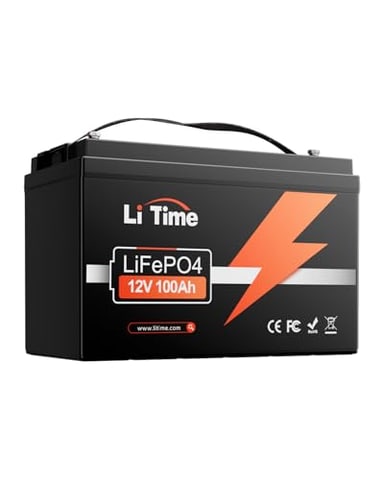
LiTime 12V 100Ah Group 31 LiFePO4 Lithium Battery
One of the cheapest 100Ah lithium batteries. The main tradeoff is base model has no low-temperature charging protection, which matters for ice fishing.
Best for: Anglers wanting the lowest-cost lithium upgrade for trolling motors and electronics.
View product details- Price band
- $150–$250
- Authority Score
- 8.2 / 10
- Chemistry
- LiFePO4 lithium
- Capacity
- 100Ah, about 1.28 kWh
- Group size
- 31
Why it works
- One of the cheapest 100Ah lithium batteries
- About 40 percent the weight of an equivalent AGM
- Full 100Ah is usable, unlike lead-acid
Watch for
- Base model has no low-temperature charging protection, which matters for ice fishing
- 100A continuous output limits the largest trolling motors
Best lithium with monitoring: ExpertPower 12V 100Ah LiFePO4
The ExpertPower 100Ah adds Bluetooth monitoring, so you can check state of charge from your phone rather than guessing, which is genuinely useful on a long day. It keeps the lightweight advantage of lithium and a long cycle life, backed by a 10-year limited warranty. The tradeoffs are price, since it costs more than the budget LiTime, and a single-unit price that runs higher than the per-unit cost of a multipack.
Best lithium with monitoring
ExpertPower · Marine Batteries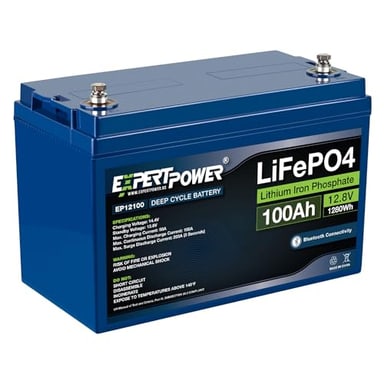
ExpertPower 12V 100Ah LiFePO4 Deep Cycle Battery with Bluetooth
Bluetooth state-of-charge monitoring from your phone. The main tradeoff is pricier than the budget LiTime lithium.
Best for: Boaters who want app-based battery monitoring in a mid-priced lithium.
View product details- Price band
- $250–$500
- Authority Score
- 7.9 / 10
- Chemistry
- LiFePO4 lithium
- Capacity
- 100Ah
- BMS
- Built-in with Bluetooth monitoring
Why it works
- Bluetooth state-of-charge monitoring from your phone
- Lightweight compared with lead-acid
- Long cycle life
Watch for
- Pricier than the budget LiTime lithium
- Single-unit price runs higher than per-unit multipack cost
Best small-cell AGM: Mighty Max ML35-12
Not every job needs a 100Ah battery. The Mighty Max ML35-12 is a sealed 35Ah AGM in a compact U1 case, right-sized to run a fish finder, an aerator, or a small kayak setup without the bulk of a full trolling motor battery. It is spill-proof and mounts in any orientation. The tradeoffs are that it is heavy for its capacity and offers limited runtime next to a 100Ah battery, so it is a companion cell, not a main motor battery.
Best small-cell AGM
Mighty Max · Marine Batteries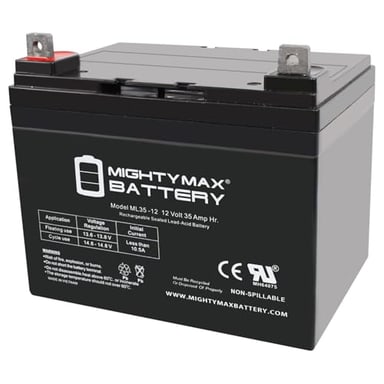
Mighty Max ML35-12 12V 35Ah U1 Deep Cycle AGM Battery
Cheap entry point for a sealed deep-cycle battery. The main tradeoff is heavy for its capacity.
Best for: Powering a fish finder, aerator, or small kayak setup on a budget.
View product details- Price band
- $100–$150
- Authority Score
- 7.6 / 10
- Chemistry
- Sealed AGM lead-acid
- Capacity
- 35Ah
- Group size
- U1
Why it works
- Cheap entry point for a sealed deep-cycle battery
- Spill-proof and mounts in any orientation
- Right size for a fish finder, aerator, or small kayak setup
Watch for
- Heavy for its capacity
- Limited runtime compared with a 100Ah battery
Fit, sizing, and handling
Two decisions drive this category. The first is chemistry. AGM is cheaper upfront and proven, but it is heavy and you should draw down only about half its rated capacity to protect its life, so a 100Ah AGM realistically gives you about 50 usable amp hours. LiFePO4 lithium costs more upfront but weighs roughly a third as much, delivers close to its full rated capacity, and lasts many times more cycles, which often makes it cheaper over the life of the battery. The one caveat for cold-weather anglers is charging: most lithium batteries should not be charged below freezing unless they have built-in low-temperature protection, so ice-fishing and late-season users should confirm that feature or choose a battery like the Dakota Lithium that is built for the cold. The second decision is physical fit. Match the group size, such as Group 31 or U1, to your boat's battery tray, and confirm the terminal type matches your trolling motor leads, since some AGM batteries use button terminals that need adapters. Finally, match voltage to your motor: a 24 volt trolling motor needs two matched 12 volt batteries wired in series.
How we picked
We compared chemistry, capacity, group size, terminal type, weight, and cycle life, and we included both AGM and lithium across a real price range so the pick matches the job and the budget. We weighted honest usable-capacity math for AGM and cold-charging limits for lithium, because those are where buyers get surprised. To match a battery to the rest of your rig, our best trolling motors guide covers motor thrust and voltage, our best fish finders roundup covers electronics that draw from these batteries, and the rest of the category lives at the fishing hub.
AGM or lithium for a trolling motor?
AGM is cheaper upfront and proven, but it is heavy and you can safely use only about half its rated capacity. LiFePO4 lithium costs more upfront but weighs roughly a third as much, gives you close to full usable capacity, and lasts many more cycles, which often makes it cheaper over its life. If weight and runtime matter and the budget allows, lithium wins; if upfront cost is the priority, AGM is the value play.
What size battery does my trolling motor need?
Match voltage first: a 12 volt motor needs one 12 volt battery, and a 24 volt motor needs two matched 12 volt batteries in series. For capacity, a 100Ah battery covers most single-motor days, though heavy use of a high-thrust motor draws it down faster. Check your motor's amp draw at full speed against the battery's usable capacity to estimate runtime.
Can I charge a lithium battery in freezing weather?
Most LiFePO4 batteries should not be charged below freezing unless they have built-in low-temperature protection, and charging a cold lithium battery can damage it. Ice-fishing and late-season anglers should confirm that a battery has low-temp charge protection or choose one built for the cold, such as the Dakota Lithium. Discharging in the cold is generally fine; it is charging that needs care.
Do I need a special charger for lithium?
Yes, LiFePO4 batteries charge best on a lithium-specific or lithium-compatible charger, and some, like the Dakota Lithium, sell the charger separately. Using an old lead-acid charger can undercharge a lithium battery or trip its protection. Budget for the correct charger when you price out a lithium upgrade.