Sonar tells you something is there; a camera tells you what it is and how it is behaving. Under the ice, that means distinguishing walleye from suckers before you waste an hour, confirming weed edges and bottom content, and watching how fish react to a jig. The buying decision comes down to cable management, screen size, lighting for stained water, recording, and how the battery holds up in the cold. Cameras complement rather than replace sonar, so pair this roundup with our best ice fishing flashers guide.
Best pocket scouting camera: Aqua-Vu Micro Stealth 4.3
The Micro Stealth is the camera that actually gets carried: a thumb-sized lens, a 4.3 inch color screen, and an integrated spool that keeps the 50 foot cable from becoming a bird nest in a coat pocket. Automatic infrared lighting extends viewing into dark and stained water, and the internal battery charges over USB and runs up to 6 hours. The compromises are inherent to the size: the small screen is hard to share with a partner, the thin micro cable takes practice to aim, and runtime drops in subzero cold.
Best pocket scouting camera
Aqua-Vu · Underwater Cameras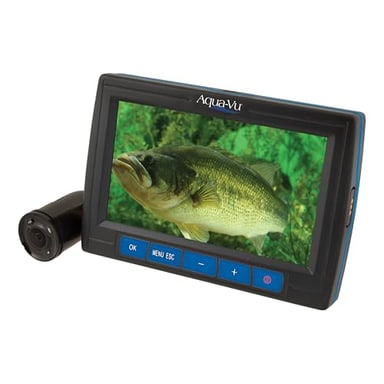
Aqua-Vu Micro Stealth 4.3
Genuinely pocket-sized with a thumb-sized micro camera. The main tradeoff is small screen is hard to share with a fishing partner.
Best for: Anglers who want a scouting camera that lives in a coat pocket and deploys in seconds.
View product details- Price band
- $150–$250
- Display
- 4.3 inch high-resolution color LCD
- Cable
- 50 foot abrasion-resistant cable with integrated spool
- Lighting
- Automatic infrared
Why it works
- Genuinely pocket-sized with a thumb-sized micro camera
- Integrated spool keeps the 50 foot cable tangle free
- Auto IR lighting extends viewing into dark or stained water
Watch for
- Small screen is hard to share with a fishing partner
- Thin micro cable takes practice to aim and pan
Best big-screen value: Aqua-Vu AV715c
Inside a shelter, screen size is the whole experience, and the AV715c delivers a 7 inch color LCD at a price meaningfully below most full-size systems. The tethered design is simple, the optics are proven Aqua-Vu glass, and infrared handles low light. You give up onboard recording, and the external 12 volt battery adds bulk that pocket cameras avoid. For hub and wheelhouse anglers who mostly watch one hole and want everyone to see the screen, it is the value play.
Best big-screen value
Aqua-Vu · Underwater Cameras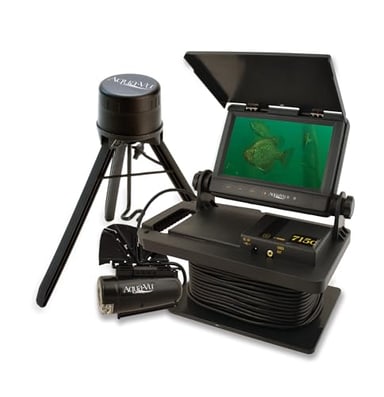
Aqua-Vu AV715c
Big 7 inch screen is easy to share inside a shelter. The main tradeoff is no internal DVR recording.
Best for: Shelter-based anglers who want a large shareable screen without a premium price.
View product details- Price band
- $150–$250
- Display
- 7 inch color LCD
- Cable
- 50 foot camera cable
- Lighting
- Infrared for low-light viewing
Why it works
- Big 7 inch screen is easy to share inside a shelter
- Costs meaningfully less than most full-size underwater cameras
- Simple tethered design with proven Aqua-Vu optics
Watch for
- No internal DVR recording
- External 12 volt battery adds bulk versus internal-battery micro cameras
Best overall ice camera: Aqua-Vu Micro Revolution Pro 5.0
The Revolution Pro earns the top spot on deployment speed: the patented spool retrieves cable like cranking a fishing reel, which turns the camera from a novelty into a legitimate run-and-gun search tool. A 5 inch screen, onboard DVR recording, and water temperature plus camera direction readouts round it out, and it works just as well from a dock or boat in summer. Outdoor Life's electronics reviewer calls it a key part of their run-and-gun arsenal. Cold still taxes the internal battery, and the ultrathin cable can be stubborn to rotate when panning.
Best overall ice camera
Aqua-Vu · Underwater Cameras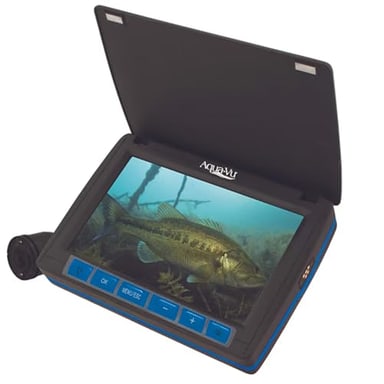
Aqua-Vu Micro Revolution Pro 5.0
Deploys and retrieves as fast as cranking a fishing reel. The main tradeoff is battery runtime decreases in subzero temperatures.
Best for: Run-and-gun anglers who treat an underwater camera as a primary search tool, not a novelty.
View product details- Price band
- $250–$500
- Display
- 5 inch smartphone-sized LCD
- Battery
- Internal lithium-ion with charger
- Recording
- Onboard DVR for underwater video and photos
Why it works
- Deploys and retrieves as fast as cranking a fishing reel
- Records video for reviewing structure and fish behavior later
- Works equally well from a boat or dock in open water
Watch for
- Battery runtime decreases in subzero temperatures
- Ultrathin camera cable can be difficult to rotate when panning the optics
Best premium 360 camera: Aqua-Vu QUAD HD
Single-lens cameras make you spin the cable to find fish; the QUAD HD points four 720p lenses in four directions and shows everything at once, so approaching fish never surprise you. Outdoor Life named it the best underwater camera in its ice electronics guide. It costs about as much as a sonar unit and a standard camera combined, which is exactly who it is for: camera-first anglers and content creators. For occasional hole checking and species ID, it is genuinely more camera than the job requires.
Best premium 360 camera
Aqua-Vu · Underwater Cameras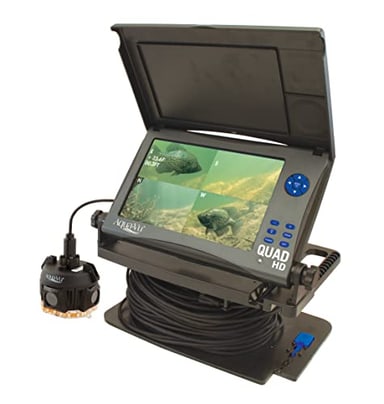
Aqua-Vu QUAD HD
Watches all four directions simultaneously, so approaching fish never surprise you. The main tradeoff is costs as much as a sonar unit and a standard camera combined.
Best for: Camera-first anglers and content creators who want full panoramic coverage under the hole.
View product details- Price band
- $500+
- Optics
- Four 720p HD lenses in a single camera module
- Coverage
- Complete 360 degree underwater view with no cable spinning
- Deployment
- One pod on one cable surveys every direction at once
Why it works
- Watches all four directions simultaneously, so approaching fish never surprise you
- Named best underwater camera in Outdoor Life's ice fish finder guide
- Eliminates the constant cable-turning of single-lens cameras
Watch for
- Costs as much as a sonar unit and a standard camera combined
- Overkill for casual hole checking and species ID
Best budget camera: MarCum Recon 5
The Recon 5 gets a real underwater camera into the budget tier: a 5 inch screen in a compact, light package that suits structure scouting on foot, with image quality that reviewers say punches above its price. Independent reviewer Virtual Angling calls it small, lightweight, and well suited to structure finding and clearwater viewing. Buy it knowing the tradeoffs our review surfaced: no built-in cable spool, polarized owner reviews that include interface and durability complaints, and frequent out-of-stock windows at MarCum direct.
Best budget camera
MarCum · Underwater Cameras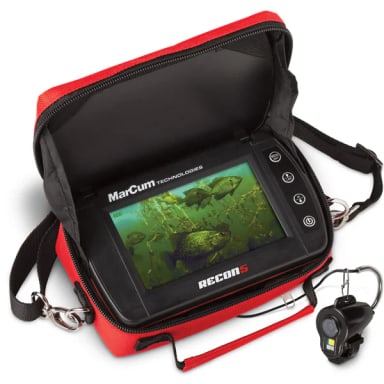
MarCum Recon 5
Small and light enough for structure scouting on foot. The main tradeoff is no built-in cable spool, so line management is manual.
Best for: Budget-focused anglers who want a proper underwater camera without crossing into premium pricing.
View product details- Price band
- $150–$250
- Display
- 5 inch screen
- Type
- Compact tethered underwater viewing system
- SKU
- 857224002750
Why it works
- Small and light enough for structure scouting on foot
- Image quality punches above its size and price class
Watch for
- No built-in cable spool, so line management is manual
- Owner reviews are polarized, with some reporting interface and durability frustrations
Best step-up with recording: MarCum Pursuit SD Plus
The current Pursuit SD Plus addresses the base Recon's biggest gaps with built-in MP4 recording to removable microSD storage, a 50 foot cable, and both infrared and visible LED lighting. Its 5 inch display also shows depth, water temperature, camera direction, and battery status, useful context when scouting quickly. The compact screen is less social inside a shelter, and the claimed six-hour runtime leaves less margin on long, very cold days.
Best step-up with recording
MarCum · Underwater Cameras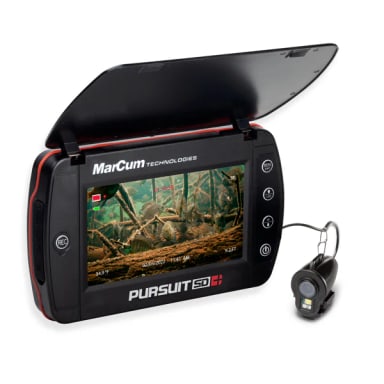
MarCum Pursuit SD Plus
Records MP4 video to removable microSD storage. The main tradeoff is 5 inch display is harder to share than a full-size shelter camera.
Best for: Mobile anglers who want a compact camera with removable recording storage and complete on-screen telemetry.
View product details- Price band
- $250–$500
- Display
- 5 inch 800 by 480 pixel screen
- Model
- PursuitSD+
- Camera
- CMOS sensor with LED and infrared lighting
Why it works
- Records MP4 video to removable microSD storage
- On-screen depth, temperature, camera direction, and battery status
- Compact package with a 50 foot cable for scouting on foot
Watch for
- 5 inch display is harder to share than a full-size shelter camera
- Six-hour claimed runtime leaves less margin on long, very cold days
Fit, sizing, and handling
Camera fit comes down to the complete shuttle, not the screen diagonal. Women, smaller anglers, and anyone working through gloves should compare carried weight, handle balance, spool resistance, cable controls, screen angle, and whether the buttons can be identified by touch. A compact unit that deploys cleanly is often more useful than a larger screen that stays in the sled.
How we picked
This category was ranked on deployment speed, cable management, lighting range, recording capability, and cold-weather runtime, using cited independent reviews at Outdoor Life and Virtual Angling, current manufacturer specifications, and recurring themes in owner feedback. A camera is most useful when you can drill enough holes to use it as a search tool, which is the case for pairing it with one of the best ice augers. The rest of the electronics conversation lives in the ice fishing hub, and current lake conditions are in the Ice & Water Report. No ice is ever one hundred percent safe, so verify every route between camera holes as you move.
Do I need a camera if I already own a flasher?
Need, no; benefit from, often. Sonar reads presence, depth, and reaction; a camera adds species ID, bottom content, and behavior. The classic use is confirming whether the marks stacked on a break are walleye or junk fish before committing an evening to them.
How well do cameras work in stained water?
Visibility is the hard limit. Infrared lighting, which every camera here carries in some form, extends viewing in dark and lightly stained water, and the Pursuit SD Plus adds visible LED for murkier situations. In truly turbid water, no lens beats sonar, which is why the two tools travel together.
Will a camera under the hole spook fish?
Owner feedback and independent reviews generally treat a quietly deployed camera as low impact, especially in deeper water. The practical cautions are movement and light: pan slowly, use only the lighting the water requires, and in shallow clear water keep the camera off to the side of your presentation rather than directly in it.
How do camera batteries handle subzero days?
Every internal-battery camera in this roundup loses runtime in deep cold; the spec sheets say so and owner feedback confirms it. Charge fully the night before, keep the unit inside your shelter or a pocket between holes, and treat claimed runtimes as fair-weather numbers.