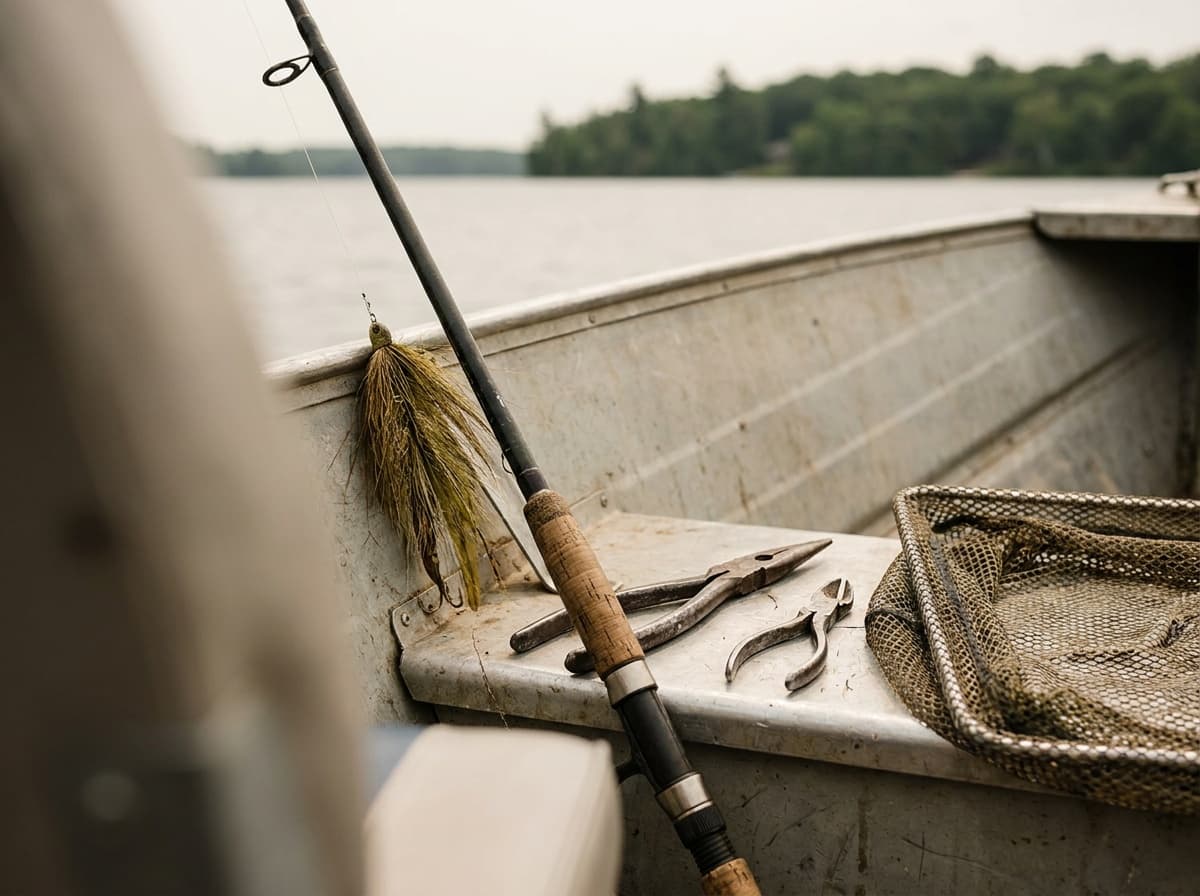
The muskellunge is North America's apex freshwater ambush predator and, for many anglers, the ultimate freshwater challenge. The Minnesota DNR calls it "perhaps Minnesota's most difficult fish to catch," a fish that can top 50 pounds and is famous for explosive strikes at the side of the boat. In Wisconsin it is the official state fish, managed through habitat protection, stocking, and regulations. New musky anglers should arrive expecting long stretches of casting between moments of chaos, and prepared to handle a very large, toothy fish responsibly.
Setting expectations
Muskies are a low-density, high-effort fish. The Minnesota DNR notes that fishing typically does not "heat up" until mid to late summer, with autumn as prime time; many of the largest fish come in October and November as muskies feed heavily before winter. Like most predators, they are most active near dawn and dusk, and cool overcast days often fish better than bright, hot ones.
Do not expect a full livewell. A successful musky outing might mean one or two follows and a single fish landed, or none at all. That math is the point of the sport, and it is why persistence and attention to detail matter more than in most fishing.
The gear class
Musky tackle is heavier than nearly anything else in freshwater, for two reasons: the lures are large and the fish are strong and toothy. The Minnesota DNR describes the standard outfit clearly.
| Component | What the DNR describes |
|---|---|
| Rod | A stout rod in the 7 to 9 foot range, matched to lure weight |
| Reel | A baitcasting reel, often with a fast gear ratio for quick retrieves |
| Line | Heavy braided line, 50 lb test or more |
| Leader | A foot-long steel or fluorocarbon leader against razor-sharp teeth |
| Lures | Large baits, commonly 5 to 10 inches or longer, including bucktails, crankbaits, topwater, and soft plastics |
Bring the landing tools too. The DNR lists a large net, needle-nose pliers, and even a small bolt cutter for stubborn hooks, plus polarized sunglasses to spot following fish. These are not optional extras; they are what makes a safe, fast release possible.
The figure-8
The single most important boat-side skill in musky fishing is the figure-8, and it exists because muskies so often trail a lure to the boat without striking. These are called follows. The Minnesota DNR describes the move: reel your lure to within about a foot of the rod tip while keeping it in the water, plunge the rod tip into the water, and sweep it in a wide figure-eight motion. A following fish will frequently commit on the turns, when the lure changes direction and speed.
Make a smooth, large figure-8 on every retrieve near the boat, not just when you see a fish, because you will not always spot the follower in time. Keep the turns wide and the lure moving; tight, jerky loops give a big fish nowhere to eat.
Release care that keeps fish alive
Because most musky waters carry high minimum size limits and most fish are released, handling technique directly affects the fishery. The Minnesota DNR statewide minimum length is 54 inches, and 40 inches on Twin Cities-area lakes stocked with tiger muskellunge, so plan on releasing nearly everything you catch. The DNR's core advice is to keep the fish in the water while removing hooks, since fish stay calmer in the water than in the boat.
A practical release sequence: fight the fish firmly rather than babying it, guide it into a large net or cradle in the water, control the head, and use long pliers or cutters to back out or snip hooks while the fish stays submerged. If you photograph it, have the camera ready and support the fish horizontally with wet hands for only a few seconds. Then hold it upright in the water and let it recover until it kicks away on its own.
For lure selection and matching baits to the season and cover, see the roundups and species guides across the fishing hub. Whatever you throw, the leader, the tools, and the figure-8 matter as much as the bait.
What size gear do I need for musky fishing?
Plan on a stout 7 to 9 foot rod, a baitcasting reel, and 50 lb or heavier braided line, plus a foot-long steel or fluorocarbon leader to protect against their teeth. This heavy class handles the large 5 to 10 inch lures muskies eat and gives you the backbone to fight and land a big fish quickly, which improves its odds on release.
What is a figure-8 in musky fishing?
It is a boatside maneuver for muskies that follow a lure without striking. As described by the Minnesota DNR, you reel the lure to within about a foot of the rod tip, plunge the tip into the water, and sweep it in a wide figure-eight. Direction changes on the turns often trigger a strike. Do it on every retrieve near the boat.
How do I release a musky so it survives?
Keep the fish in the water, minimize handling time, and have long pliers or hook cutters ready before you land it. Research links release mortality to warm water and long handling, so work fast, support the fish horizontally for any photo, and revive it upright until it swims off. Always confirm the size limit for your water, since most muskies must be released.
Sources
- Minnesota DNR, How to catch a muskellunge
- Wisconsin DNR, Wisconsin's state fish: the muskellunge
- Booth, I.T., et al., Evaluating Muskellunge catch-and-release mortality, Transactions of the American Fisheries Society (2023)