GPS tracking answers a different question than an e-collar does. An e-collar reinforces commands within sight or earshot; a tracking system tells you where a dog is when it is out of both. This roundup is dedicated to that job, so it covers true GPS handhelds and tracking collars rather than the training collars in our broader best hunting dog gear guide. The two work together, and several units here add training on top of tracking, but the reason to buy is location. The honest divider is how your dog hunts. Close-working flushers rarely leave sight, while big-running hounds and pointers can be a mile out in heavy timber, and the right choice follows range, terrain, and whether you need satellite communication where phones go dark. For the other half of the year, when the same dog is a house pet rather than a hunting partner, House Pet Authority's guide to the best GPS trackers for dogs covers the lighter everyday cellular units built for backyard escapes rather than 9-mile casts.
Best overall tracking system: Garmin Alpha 200i
The Alpha 200i is the system that shows up on the most tailgates for good reason: up to 9 miles of tracking range, a 3.5 inch glove-friendly touchscreen with preloaded topo maps, and built-in inReach two-way satellite messaging and SOS for hunts beyond cell service. It tracks and trains up to 20 dogs from one handheld. The inReach features need a separate satellite subscription, and depending on the bundle the collar is often sold separately, so confirm what is in the box before ordering.
Best overall tracking system
Garmin · Dog Tracking & Training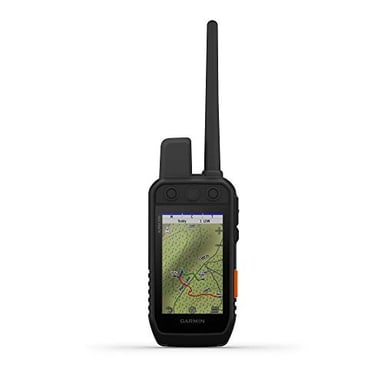
Garmin Alpha 200i Handheld with inReach
Adds inReach satellite messaging and SOS for hunts beyond cell coverage. The main tradeoff is inReach messaging and SOS require a separate satellite subscription.
Best for: The backcountry houndsman or upland hunter who wants tracking plus satellite communication where there is no cell service.
View product details- Price band
- $500+
- Authority Score
- 8.7 / 10
- Range
- Up to 9 miles tracking range with a compatible collar
- Comms
- Built-in inReach two-way satellite messaging and SOS with an active subscription
- Display
- 3.5 inch glove-friendly color touchscreen with preloaded TopoActive maps
Why it works
- Adds inReach satellite messaging and SOS for hunts beyond cell coverage
- Full-color topo touchscreen works without a paired phone
- Combines dog tracking and e-collar training in one handheld
Watch for
- inReach messaging and SOS require a separate satellite subscription
- Collar is often sold separately depending on the bundle
Best value into the Garmin ecosystem: Garmin Alpha 10
The Alpha 10 is the least expensive way onto Garmin's Alpha platform. It skips the built-in map screen and instead pairs with the Garmin Alpha app on a phone you already carry, while keeping the same 9-mile range and the same collar compatibility as the flagship units. That makes it easy to clip to a vest and forget. The tradeoff is direct: with no standalone screen it leans on a charged phone in the field, and the collars are sold separately, which adds meaningfully to the real cost of a working setup.
Best value into the Garmin ecosystem
Garmin · Dog Tracking & Training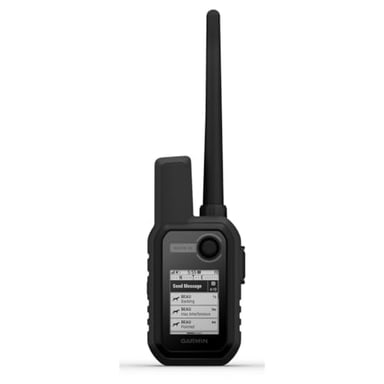
Garmin Alpha 10 Handheld Dog Tracker
Lowest-cost entry into the Garmin Alpha tracking ecosystem. The main tradeoff is no standalone map screen, so it depends on a charged phone in the field.
Best for: The handler who wants Garmin Alpha tracking at the lowest cost and is comfortable running maps from a phone.
View product details- Price band
- $250–$500
- Authority Score
- 8.3 / 10
- Range
- Up to 9 miles line of sight with a compatible collar
- Dogs
- Track and train up to 20 dogs
- Display
- No built-in map screen; pairs with the Garmin Alpha app on a phone for mapping
Why it works
- Lowest-cost entry into the Garmin Alpha tracking ecosystem
- Compact handheld clips to a vest and pairs with a phone you already carry
- Same collar compatibility as the flagship Alpha handhelds
Watch for
- No standalone map screen, so it depends on a charged phone in the field
- Collars are sold separately, which adds meaningfully to the real cost
Best flagship handheld: Garmin Alpha 300i
The Alpha 300i is Garmin's current top handheld, with an updated interface, faster processing, multi-band positioning for tough canopy and terrain, and the same inReach satellite messaging and SOS as the 200i. It tracks dogs and members of the hunting party together on a sunlight-readable touchscreen. The cost is the catch, since it sits at a premium before you add a collar, and like every inReach device its satellite features require an active subscription.
Best flagship handheld
Garmin · Dog Tracking & Training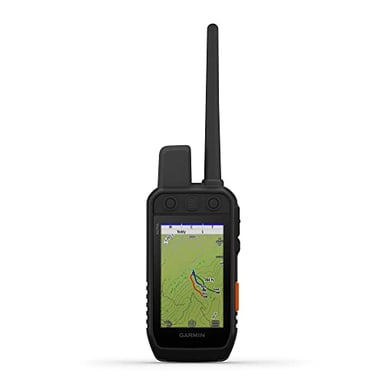
Garmin Alpha 300i Handheld with inReach
Current flagship handheld with an updated interface and faster processing. The main tradeoff is premium pricing before adding a collar.
Best for: The serious houndsman who wants Garmin's newest tracking platform with the widest feature set.
View product details- Price band
- $500+
- Authority Score
- 8.5 / 10
- Range
- Up to 9 miles tracking range with a compatible collar
- Comms
- Built-in inReach satellite messaging and SOS with an active subscription
- Display
- 3.5 inch sunlight-readable color touchscreen
Why it works
- Current flagship handheld with an updated interface and faster processing
- inReach satellite coverage plus multi-band positioning for hard terrain
- Tracks both dogs and members of a hunting party
Watch for
- Premium pricing before adding a collar
- Satellite features require an active subscription
Best value tracking and training: Dogtra Pathfinder 2
The Pathfinder 2 keeps cost down by dropping the dedicated handheld entirely and using your smartphone as the display through the free Pathfinder app. It delivers up to 9 miles of range, combines GPS tracking with e-collar training, expands to 21 dogs, and works without cell coverage by linking the connector to the phone directly. The catch is that same phone dependency: a dead or cold phone takes the map with it, and range and interface quality track with phone and app performance.
Best value tracking and training
Dogtra · Dog Tracking & Training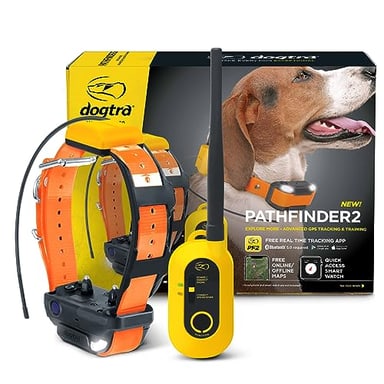
Dogtra Pathfinder 2 GPS Tracking and Training Collar
App-based system keeps the cost well below dedicated handhelds. The main tradeoff is depends on a charged smartphone for the map display.
Best for: The budget-minded handler comfortable running tracking and training from a smartphone app.
View product details- Price band
- $250–$500
- Authority Score
- 7.9 / 10
- Range
- Up to 9 miles range via the free Pathfinder app
- Display
- Uses a paired smartphone as the display; no separate handheld
- Function
- Combined GPS tracking and e-collar training
Why it works
- App-based system keeps the cost well below dedicated handhelds
- Combines tracking and training without carrying a separate unit
- Works without cell coverage by linking the connector to a phone
Watch for
- Depends on a charged smartphone for the map display
- Interface and range depend on phone and app performance
Best add-on collar for a multi-dog string: Garmin Alpha T 20
Handlers running more than one dog need collars, not another handheld, and the Alpha T 20 is the add-on that pairs with the Alpha 10, 200i, and 300i to bring a second or third dog onto an existing system. It combines up to 9 miles of tracking with e-collar stimulation, tone, and vibration, on a rechargeable battery rated for multi-day hunts. It only works with a compatible Alpha handheld, and outfitting a full string of dogs adds up quickly, so budget the collars into the system cost from the start.
Best add-on collar for a multi-dog string
Garmin · Dog Tracking & Training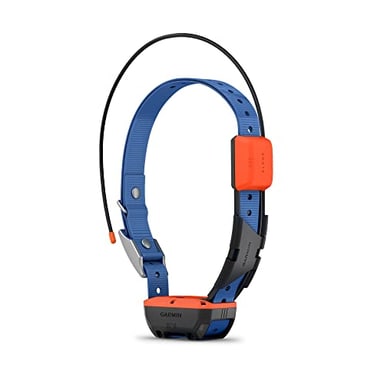
Garmin Alpha T 20 Dog Tracking and Training Collar
Adds a second or third dog to an existing Alpha handheld. The main tradeoff is requires a compatible Alpha handheld to function.
Best for: The multi-dog handler expanding an existing Garmin Alpha system to another dog.
View product details- Price band
- $150–$250
- Authority Score
- 8.4 / 10
- Type
- Add-on tracking and training collar for Garmin Alpha handhelds
- Range
- Up to 9 miles with a compatible Alpha handheld
- Training
- Adds e-collar stimulation, tone, and vibration to tracking
Why it works
- Adds a second or third dog to an existing Alpha handheld
- Combines tracking and training in a single collar
- Rechargeable battery lasts across long hunts
Watch for
- Requires a compatible Alpha handheld to function
- Collar cost adds up quickly when running a multi-dog string
Matching range, terrain, and communication to your hunt
A tracking system is chosen by how far the dog gets and how far help is. Range is the first filter: close flushers and retrievers rarely test even a fraction of these numbers, while hounds and versatile pointers can justify every mile. Terrain is the second, since heavy timber and deep draws break line of sight and reward faster update rates and multi-band positioning. Communication is the third and most personal: hunters who work country with no cell signal gain a real safety margin from inReach messaging and SOS, while those who stay near coverage can save that cost. For handlers, weigh screen size, glove-friendly controls, and whether a phone-based system fits how you already carry gear.
Fit, sizing, and handling
Fit here applies to two bodies. On the dog, the collar should sit high on the neck with the antenna angled up, snug enough that two fingers slip under the strap but not tight enough to rub on a long day. Collar and battery weight matters most on smaller dogs, so check the manufacturer's minimum weight guidance before strapping a full-size unit on a dog under roughly 25 pounds, and trim the excess strap so it cannot snag in cover. On the handler side, weigh handheld size and glove-friendly controls against how you already carry gear. A phone-paired unit saves bulk and reach, while a larger dedicated screen is easier to read with cold hands or with reading glasses off.
How we picked
We compared published specifications and consistent themes in owner and handler feedback, weighting tracking range, update rate, mapping and screen quality, battery life across a long day, multi-dog capacity, and whether the system adds satellite communication or training. This page stays focused on GPS location systems, which is why the training-collar decision lives elsewhere. For e-collars, protective vests, and field first aid, see our best hunting dog gear roundup, and find the rest of the handler's kit across the hunting dogs hub.
How much tracking range do I actually need?
Match range to how your dog hunts. Close-working flushers and retrievers rarely leave a few hundred yards, so raw miles matter less than screen and battery. Big-running hounds and versatile pointers in heavy cover are where 9 or 10 miles and a fast update rate earn their keep. Buying more range than your breed uses adds cost without adding control.
What is the difference between a tracking collar and an e-collar?
An e-collar reinforces known commands at close range with tone, vibration, or stimulation. A GPS tracking system tells you where a dog is when it is out of sight, sometimes miles away. Several units here do both, but the reason to buy a tracker is location. For the training side, see our best hunting dog gear guide.
Do I need the inReach satellite feature?
Only if you hunt where phones lose signal. inReach two-way messaging and SOS on the Alpha 200i and 300i add a genuine safety margin in the backcountry, but they require a separate subscription. Handlers who stay within cell coverage can choose a unit without it and put that money elsewhere.
Can one handheld track more than one dog?
Yes. Every system here tracks multiple dogs, up to 20 or 21 depending on the unit, but each dog needs its own collar. That is why add-on collars like the Alpha T 20 matter for a multi-dog string: the handheld cost is fixed, and the collars are what scale with the number of dogs you run.